
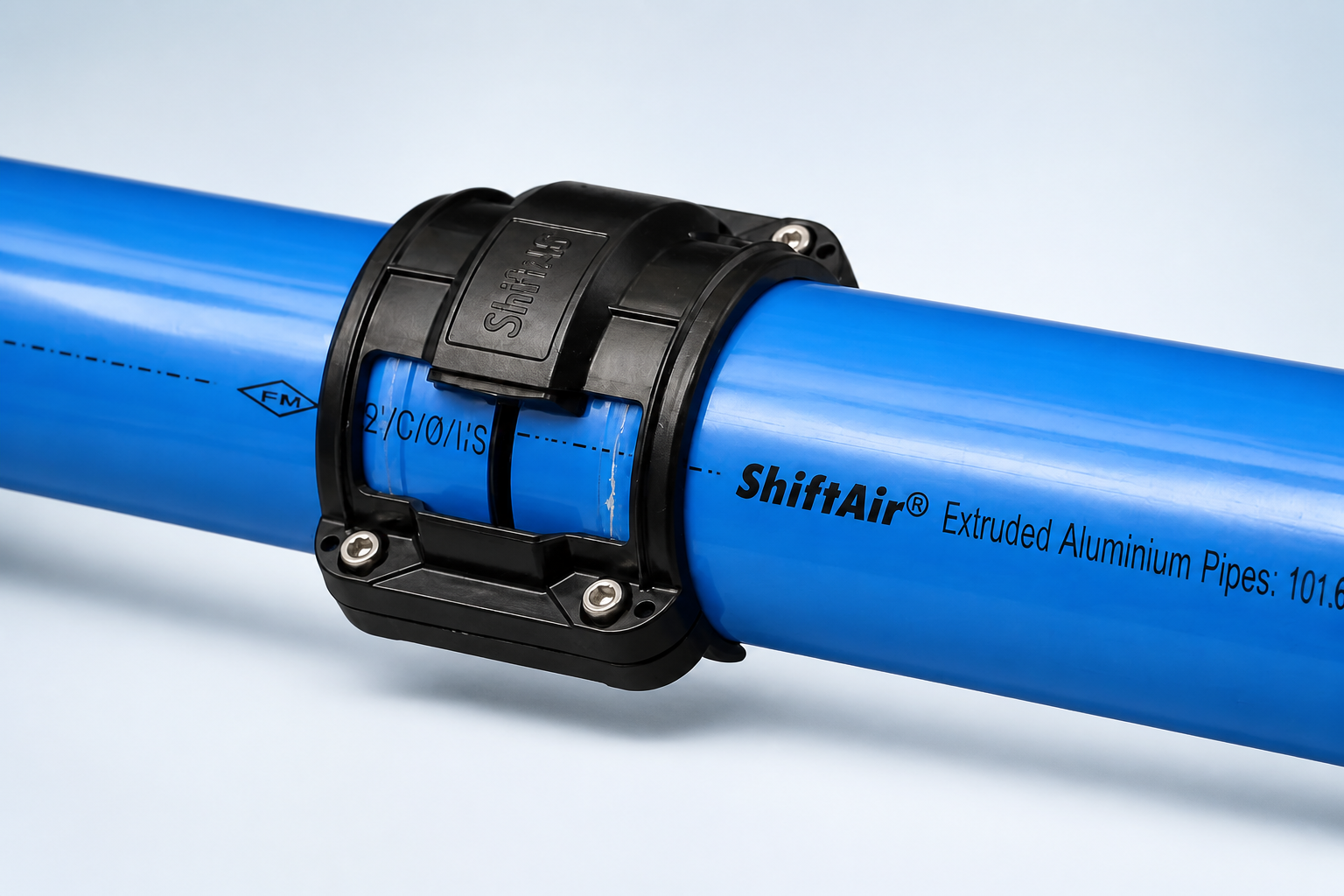
Aluminium Compressed Air Piping Systems in India: Manufacturer, Supplier & Turnkey Contractor — Complete Technical, Cost & ROI Guide for Industrial Plants
Compressed air is often called the “fourth utility” of modern industry—after electricity, water, and gas. But unlike electricity, compressed air is generated on-site at enormous energy cost, and a significant portion of that cost is lost before the air ever reaches a pneumatic tool, cylinder, or machine. In most Indian plants running on galvanised iron (GI) or mild steel (MS) pipework, the distribution network itself is the single largest source of avoidable energy loss, pressure instability, and maintenance downtime.
This is not a matter of marginal efficiency. It is a structural problem. GI and MS piping corrode from the inside out. The internal bore roughens, scales, and narrows. Threaded joints leak. Weld seams fail. The compressor is forced to run harder to compensate for pressure that never reaches the point of use. And because the deterioration is gradual, the cost accumulates invisibly—month after month, year after year—until the system is replaced.
Aluminium compressed air piping systems have emerged as the engineering answer to this problem in India. They are corrosion-free by material, modular by design, and dramatically faster to install than welded steel. But not all aluminium systems are equal, and not every supplier is equipped to deliver the engineering, installation, and lifecycle support that a plant actually needs.
This guide is written to cut through the noise. It compares aluminium against every common alternative, explains the technical standards that matter, provides a transparent costing framework, and lays out exactly how to evaluate a manufacturer, supplier, and turnkey contractor in India—using Shiftair Transmission Pvt. Ltd.’s 2026 technical catalogue as the reference standard for what an industrial-grade system should look like.
If you are new to this subject, start with what a compressed air piping system is and why it matters in modern factories, then return to this guide for the engineering detail.
The Hidden Cost of Your Compressed Air Distribution Network
The Six-Stage Failure Chain of GI and MS Piping
In our field work across Indian plants, we have observed that galvanised iron and mild steel piping do not fail suddenly. They degrade through a predictable sequence—one that most plant managers recognise only in hindsight, when the compressor is already running hot and the electricity bill has already climbed. We call it the six-stage failure chain, and it typically unfolds over twelve to fifteen years.
The sequence is not random. Each stage creates the conditions for the next, which is why the degradation accelerates once it begins and why the eventual replacement becomes unavoidable rather than elective.
Stage 1 — Coating Breakdown (Years 1–3). The internal zinc layer on GI pipe begins to degrade under the acidic condensate that forms continuously in compressed air lines. Compressed air exits the compressor saturated with moisture, and the aftercooler and dryer remove most—but never all—of it. The residual moisture combines with trace contaminants in the air to form a mildly acidic solution that attacks the zinc coating from the inside. In plants with poor dryer performance, high ambient humidity, or frequent compressor cycling, this begins within the first three years. Bare MS pipe has no protective coating at all and begins oxidising in the first year.
Stage 2 — Scale Accumulation (Years 3–10). Iron oxide and scale deposit on the internal bore, progressively narrowing the effective flow area. The deposits are not uniform—they build up in patches, creating localised restrictions that create turbulence and accelerate further deposition. By the eighth to tenth year, it is common to find the effective internal diameter reduced by fifteen to twenty-five percent. A header sized at 100 mm may be delivering the flow of a 75 mm pipe.
Stage 3 — Transition to Turbulent Flow (Years 5–12). As the bore narrows and the surface roughens, air velocity rises to maintain the same mass flow rate. Once velocity exceeds the critical threshold for the pipe geometry and pressure, the flow regime shifts from laminar to turbulent. Friction losses increase disproportionately—not linearly—and the pressure drop across the network begins to climb faster than the scale thickness would suggest.
Stage 4 — Compressor Overload (Years 8–13). To hold 7 bar at the furthest point of use, the compressor must now discharge at 8.5 bar or higher. Every additional bar of discharge pressure carries a measurable electricity penalty—7% to 8% of compressor energy per bar, based on industry benchmarks. In a plant running a 100 HP compressor for two shifts, that extra 1.5 bar of discharge pressure represents roughly ₹2.5–3 lakh per year in avoidable electricity cost, every year, for the remaining life of the system.
Stage 5 — Downstream Contamination (Years 6 onwards, accelerating). Loose oxide particles detach from the pipe wall and travel downstream. They clog coalescing filters ahead of schedule—often at 40–50% of their rated service life. They score cylinder bores in pneumatic actuators and valves, causing seal failures and unplanned downtime. They jam solenoid valves, contaminate paint finishes in automotive plants, and violate air-purity standards in pharmaceutical cleanrooms.
Stage 6 — Forced Replacement (Years 12–15). By year twelve to fifteen, leaks appear faster than they can be repaired. Pressure drop can no longer be compensated for without pushing the compressor beyond its efficient operating range. The only remaining option is a full shutdown and replacement—often at a cost that includes the piping material, installation labour, production downtime, and the emergency procurement premium for fast delivery.
The compounding effect. Each stage is individually survivable. The damage comes from the fact that they compound silently, and the plant only measures the cumulative effect when it is already locked in. A plant that replaced its GI network at year fourteen spent roughly 1.8× the original specification cost—in energy, maintenance, and emergency replacement—compared to what an aluminium system would have cost on day one.
Why “Cheap” Piping Becomes the Most Expensive Decision in Your Plant
The initial cost of GI or MS piping is undeniably lower than aluminium on a per-metre material basis. This is the number that wins the purchase order. It is not the number that determines what the plant pays over a decade.
Shiftair’s catalogue quantifies the energy penalty with a benchmark worth memorising: for every 0.14 bar reduction in pressure drop, system efficiency improves by 1%. Run the arithmetic forward. A compressor discharging at 6.9 bar instead of 5.5 bar is carrying roughly 1.4 bar of avoidable pressure—which, at 0.14 bar per percentage point, works out to approximately 10% of the compressor’s electricity cost.
Now cross-check that against the industry rule of thumb: every extra bar of compressor discharge pressure costs 7% to 8% more electricity. Divide 10% by 1.4 bar and you get roughly 7.1% per bar. Two independent methods converge on the same answer.
That convergence matters, because it means pressure drop is not a technical footnote buried in a design calculation. It is your electricity bill, expressed in bar. And in a plant where the compressor is typically the largest single electrical load, a 7% reduction in its consumption is a line item that shows up in every month’s accounts. Leakage and pressure drop costs real money—and both are eliminated by design, not by maintenance.
Set that against the full cost stack: compressor energy penalty, leakage losses, filter and seal replacement, production downtime for welded repairs, and the eventual full replacement. The “cheap” system becomes the most expensive line item in the compressed air budget—not because anyone made a bad decision, but because the decision was made on the wrong number.
Aluminium changes this equation not by being inexpensive to buy, but by being inexpensive to own. Its corrosion-free bore stays smooth for decades. Its mechanical joints do not degrade like threaded steel. Its modular design allows modification without welding or hot work. The material premium is recovered through energy savings, reduced maintenance, and the avoidance of a mid-life replacement—and the section on total cost of ownership below shows exactly how that arithmetic works.
The Indian Compressed Air Piping Market in 2026
The case for aluminium compressed air piping is being made in a market environment that has shifted decisively in its favour. Four trends are reshaping how Indian manufacturers think about their air distribution networks.
Manufacturing Expansion and Greenfield Plants
India’s manufacturing sector is expanding at a pace not seen since the 2008–2011 boom. PLI (Production Linked Incentive) schemes across electronics, pharmaceuticals, textiles, speciality chemicals, and white goods have driven a wave of greenfield plant construction. Every greenfield plant requires a compressed air piping system, and the specification decision made at the design stage locks in the cost of distribution for the next two decades.
Energy Cost Pressure
Industrial electricity tariffs in India have risen steadily, with the average commercial-industrial rate now in the range of ₹7–9 per kWh depending on the state and load profile. For a plant running a 150 HP compressor for 6,000 hours per year, every 1% of efficiency improvement is worth roughly ₹1.1 lakh per year. A pressure drop reduction from 1.0 bar to 0.3 bar—a realistic improvement with an aluminium retrofit—is worth roughly ₹5–6 lakh per year.
Sustainability and Carbon Reporting
The largest Indian industrial groups—and their global customers—now report Scope 1 and Scope 2 emissions with increasing rigour. Compressed air is a major Scope 2 contributor, and it is one of the easiest to reduce because the inefficiencies are well-understood and the interventions are proven. Aluminium piping is a directly attributable improvement.
Labour and Safety Cost
Welded steel installation requires skilled welders, hot work permits, fire watch, and production downtime—each of which has become more expensive and more disruptive over the past decade. The push-fit and clamp-fit installation model eliminates all of these costs.
These four trends converge on the same conclusion: the aluminium system that was once viewed as a premium specification is now the pragmatic specification. The material premium, where it still exists, is smaller than the cost of the alternatives over the system’s expected life.
Aluminium vs. GI, MS, Stainless Steel, and PPR: The Definitive Comparison
Internal Corrosion and Air Purity
This is the foundational difference. Aluminium does not rust. Shiftair’s aluminium pipes are manufactured from 6063-T5 alloy, a seamless extruded grade conforming to EN 755.2 and EN 573.3. In compressed air service, where residual moisture is always present downstream of the dryer, aluminium forms a thin, stable oxide layer that passivates the surface and protects the metal beneath. The internal bore remains clean and dimensionally stable for the life of the installation.
GI and MS steel are severely vulnerable by comparison. Shiftair’s technical literature is direct on the point: aluminium piping systems are designed to eliminate the rust-related problems inherent in traditional GI and MS networks. PPR offers no corrosion risk but introduces a different concern—micro-plastic shedding into the air stream, and joint integrity that degrades under repeated thermal cycling. Stainless steel is corrosion-free and excellent in service, but carries a significantly higher material and fabrication cost that is difficult to justify across an entire plant distribution network.
For industries where air purity is non-negotiable—pharmaceutical cleanrooms, food and beverage processing, electronics assembly—aluminium systems support compliance with ISO 8573-1:2010 air quality classes when paired with appropriate upstream drying and filtration.
Leakage Risk and Pressure Drop
Leakage is the silent thief of compressed air economics. In a threaded steel network, every joint is a potential leak path, and corrosion at threaded connections accelerates the problem over time. Welded joints are leak-free initially but can crack under vibration and thermal cycling.
Shiftair’s connection technology—gripping-ring push-fit fittings for smaller diameters, cold-deformation clamp-fit fittings for larger ones—is engineered to deliver zero-leak piping systems, supported by in-house hydrostatic pressure testing, flow analysis, and air leak detection at every level of assembly.
Pressure drop follows the same pattern. The rough, corroded bore of an aging steel pipe creates friction that manifests as pressure loss across the network. Shiftair pipes are manufactured with a smooth, full bore that promotes maximum airflow and minimises pressure drop.
Installation Speed and Future Modification
A welded steel installation requires hot work permits, skilled welders, fire watch, and usually production shutdowns in the affected area. A push-fit or clamp-fit aluminium system requires no welding, no threading, and no hot work permits at all. Shiftair’s catalogue states that its systems are ready to use in over 50% less time than conventional piping.
Future modification is where the modular advantage becomes most visible. Adding a machine drop to a welded steel line means cutting, welding, pressure testing, and repainting—typically a planned shutdown. Adding a drop to a Shiftair system means isolating the section, cutting the pipe, fitting a tee, and assembling the connection. See our guide on expanding a compressed air network without a production shutdown.
Lifecycle Cost and Total Cost of Ownership (TCO)
Shiftair provides a 10-year warranty on all aluminium piping and fittings. That is a contractual commitment and it is exceptional in this market—most steel fabricators offer one year, and most importers offer one to two. But a warranty is not the same thing as a service life, and the two should not be conflated.
The service life case rests on the component specification data. The SS304 gripping ring carries a 50-year design life. The Qualicoat powder coating is rated for 20 years in indoor applications. The cross-linked NBR seals have a 15-year shelf life under ISO 2230. And the aluminium alloy itself has no specified shelf life and does not age-harden.
Taken together, these component specifications support a 20-year-plus service horizon for a correctly installed and maintained system, against a 10-year warranty that covers the first half of it. Our full aluminium vs GI pipe cost and ROI guide walks through the arithmetic against real plant data.
Comparison Matrix: Material Performance at a Glance
| Criteria | MS / GI Steel | PPR (Plastic) | Stainless Steel | Shiftair Aluminium |
|---|---|---|---|---|
| Internal Corrosion | Severe | None | None | Zero |
| Contribution to Air Purity | Poor — rust and scale shedding | Moderate — micro-plastic risk | Excellent | Excellent — supports ISO 8573-1:2010 compliance |
| Leakage Risk | High — threaded joints, weld fatigue | Medium — thermal cycling at joints | Medium — threaded joints | Zero-leak design |
| Pressure Drop Behaviour | High, and rising with age | Moderate, stable | Low, stable | Low and stable — smooth full bore |
| Installation Speed | Slow — cut, thread, weld | Moderate | Moderate — welding or heavy threading | 50%+ faster than conventional |
| Future Expansion | Major rework, planned shutdown | Moderate rework | Major rework | Fast modular addition, no hot work |
| Hot Work Required | Yes | No | Yes | No |
| Thermal Expansion | Moderate — needs expansion loops on long runs | High — needs more expansion provision | Moderate | Moderate — expansion loops on long runs, same as steel |
| UV Resistance (Outdoor) | Coating-dependent | Degrades without UV stabiliser | Excellent | Qualicoat 20-year indoor rating; UV-stable topcoat available for external |
| Fire Safety | Non-combustible | Combustible — adds fire load | Non-combustible | Non-combustible — no additional fire load |
| Recyclability | High scrap value | Low | High | High — infinitely recyclable, strong scrap value |
| Internal Bore Stability | Degrades with age | Stable | Stable | Stable — smooth full bore for life |
| Typical Service Life | 5–8 years | 8–12 years | 20+ years | 20+ years, supported by component design life |
| Warranty Offered | ~1 year typical | 1–2 years | 1–2 years | 10 years |
For a deeper treatment of the switching decision, see why industries are switching to modular aluminium piping systems and the benefits of aluminium pipe for reliable industrial air distribution.
What Goes Into a Complete Aluminium Piping System
A compressed air piping system is more than pipe. The pipe is the largest visual component and the largest share of material cost, but the performance of the network—its leak rate, its pressure drop, its service life—depends on the fittings, valves, supports, and accessories that connect and control it. When evaluating a quotation, each of these categories should appear as a line item.
Pipes
Shiftair’s pipe range runs from 20 mm to 250 mm OD, in 6063-T5 blue alloy and grey alloy variants for different application conditions. The pipe is supplied in standard lengths with the exterior powder-coated to the specified RAL colour and the interior left smooth and untreated—the natural aluminium oxide layer is the corrosion protection.
Fittings
Fittings make up a larger share of total cost than most buyers anticipate, because a real network requires far more of them than a schematic drawing suggests. The standard fitting set includes:
- Equal tees and reducing tees for branch take-offs.
- Equal elbows 90° and 40° for direction changes.
- Male threaded elbows for connection to equipment with threaded ports.
- Unequal connectors for diameter transitions.
- Aluminium flange connectors for equipment interfaces.
- End caps for terminating runs and drain points.
Valves
Isolation valves allow sections of the network to be shut off for maintenance without draining the entire system. The standard valve set includes forged brass ball valves up to 50 NB, quick push-in ball valves, single-port and double-port female ball valves, and flanged butterfly valves for larger-diameter isolation at main headers.
Supports and Brackets
Support spacing and bracket selection determine whether the network stays straight and level over its life. The standard support set includes quick-assembly U-brackets, quick-assembly straight brackets, L-brackets, beam clamps, cantilever mounting brackets, fixing clamps, threaded rods, and Allen bolts.
Accessories and Instrumentation
Instrumentation makes the system visible. The standard accessory set includes glycerine-filled pressure gauges (SS304 body, EN837-1, ±1% FSD accuracy) at every major branch and drop, flow meters at zone boundaries for consumption monitoring, pressure regulators at machine drops where pressure varies by tool, and filters and separators at the point of use.
Installation Tools
Push-fit and clamp-fit systems require a small, specific tool set—not a welding plant. Shiftair supplies the tools needed for correct installation: pipe cutter, hole saw cutter, pipe deburring tool, hole deburring tool, pipe marker, drill holder tool, cordless driver kit, and lugging machines for grooving preparation at larger diameters.
Technical Specifications That Separate Industrial-Grade Systems from Commodity Pipes
Alloy Composition and Mechanical Standards
The aluminium used in compressed air piping is not the same alloy as window framing or beverage cans. Shiftair specifies 6063-T5 alloy for its seamless extruded pipes—manufactured in accordance with EN 755.2 and EN 573.3. This magnesium-silicon formulation offers a combination of extrudability, corrosion resistance, and mechanical strength that suits pressure service up to 15 bar.
The fittings are pressure die-cast aluminium to Grade A383, selected for dimensional consistency and mechanical integrity at the joint—which is where failures actually occur in any piping system. At the larger diameters, elbow bodies are cast in SS304 stainless steel for additional strength at the point of highest stress.
Pressure Ratings and Temperature Envelopes
Shiftair’s standard modular system carries a maximum working pressure of 15 bar, with burst pressure tested to 60 bar—a four-to-one margin over the working rating that provides substantial headroom for pressure surges and compressor cycling. The system is also rated for vacuum service down to 15 millibar, and the working temperature range is –20°C to +70°C, with cross-linked NBR seals carrying a documented 15-year shelf life under ISO 2230.
Internal Bore Finish and Flow Characteristics
Shiftair pipes are specified with a smooth and full bore to ensure maximum airflow and minimum pressure drop. The external finish is specified to the same standard: approximately 80 microns of coating on pipes and 20 microns on fittings, in a standard colour code of RAL5012 for pipes and RAL9004 for fittings. The coating is Qualicoat-certified powder coating, rated for 20 years in indoor applications.
Fitting Technology: Gripping-Ring (20–40 mm) and Cold-Deformation Clamp-Fit (50–250 mm)
Shiftair uses two distinct connection technologies, matched to the diameter band. This is a genuine engineering decision rather than a product-range accident, and it is worth understanding because it affects both reliability and installation time.
20 mm to 40 mm — Gripping-Ring Push-Fit Technology. In this range, joints are secured by cold-worked austenite steel SS304 gripping rings, which provide the mechanical strength of the pipe-to-pipe and pipe-to-fitting connection. The gripping ring is what prevents the pipe from being pushed out under pressure—a failure mode known as “snipping” that afflicts poorly designed push-fit systems. The seal is a cross-linked NBR flat seal, and the assembly is secured with high-tensile galvanised bolts.
50 mm to 250 mm — Cold-Deformation Clamp-Fit (Grooving). From 50 mm upward, the pipe end is prepared by cold deformation—grooving—which delivers higher mechanical strength and reliability at the larger diameters where the forces on a joint are correspondingly greater. The connection uses an aluminium clamp shell with a cross-linked NBR flat seal, an SS gripping ring, and high-tensile bolts.
Certification and Compliance: ISO, ASME, and Indian Standards
Shiftair’s technical documentation confirms compliance with ISO 8573-1:2010 compressed air quality classification, ASME B31.1 and B31.3 pressure piping design codes, PED 2014/68/EU, EN 755.2 and EN 573.3 aluminium material standards, ISO 9001:2015 quality management certification, and ISO 2230 for seal shelf life. Request the full certificate set before placing a purchase order—the answer will tell you more than the brochure.
The Push-Fit Advantage: Installation Without Welding, Threading, or Hot Work
Step-by-Step Installation Workflow
Installing a Shiftair system follows a clean, repeatable sequence requiring minimal tooling and no hot work permits:
- Site survey and layout marking. The route is marked against the approved isometric drawing, with support locations identified.
- Support installation. Brackets and clamps are fixed at specified spacing—quick-assembly U-brackets and straight brackets are the standard components.
- Pipe cutting and deburring. Pipe is cut to length with the pipe cutter and deburred with the pipe deburring tool.
- Fitting assembly. For 20–40 mm, the pipe is inserted into the fitting; the SS304 gripping ring provides mechanical strength and the cross-linked NBR seal provides the leak-tight barrier. For 50 mm and above, the pipe end is grooved by cold deformation and the clamp-shell fitting is assembled with seal and high-tensile bolts. No welding, threading, or gluing at any stage.
- Pressure testing. The section is pressurised and held to confirm joint integrity.
- Commissioning and handover. Connection to compressor and air treatment, final leak check, and handover.
Shiftair supports this with installation guidance and training—on-site support, detailed manuals, and training sessions so that client teams can correctly assemble the system themselves. For a detailed walkthrough, read our step-by-step compressed air pipe installation guide for factory projects.
Tools, Crew Size, and Time Estimate
One of the less-discussed advantages of push-fit installation is the crew size and skill profile it requires. A welded steel installation needs a certified welder, a helper, a fire watch, and often a fitter for pipe preparation—four people minimum. A push-fit installation needs two people: one cutting and deburring, one assembling and positioning. The second person can be trained in a day.
Why “No Hot Work” Matters in Indian Plants
Hot work permits are a major bottleneck in Indian industrial environments. Welding or cutting in a production area typically requires a formal permit-to-work approval, fire watch personnel and firefighting equipment on standby, isolation and cleaning of adjacent equipment, shutdown of production in the affected zone, and post-work inspection and sign-off. A push-fit or clamp-fit installation eliminates every one of these requirements.
For plants that cannot afford extended shutdowns—which is most Indian manufacturing plants—this is not a convenience. It is the difference between a project that completes on schedule and one that slips by weeks waiting for a shutdown window that never quite arrives. Our article on common compressed air piping installation mistakes covers the failure modes this avoids.
Design Engineering: Pipe Sizing, Pressure Drop, and Layout Principles
The Velocity Method for Compressed Air Pipe Sizing
Shiftair provides a Flow and Diameter Calculator that takes system flow rate and length and recommends the diameter that achieves minimal pressure drop. The underlying principle is the velocity method. Compressed air piping is sized so that the air velocity stays within a band appropriate to the pipe’s role in the network: main headers and ring mains 6–8 m/s, branch lines 8–12 m/s, and drops and final connections 12–15 m/s. For a full treatment, see our compressed air pipe sizing guide.
Ring Main vs. Branch Layout for Indian Plant Footprints
Indian plants typically use one of two layouts. Branch (tree) systems use a main header with branches feeding individual areas, and are simpler and cheaper to install but suffer cumulative pressure drop along the main, so the furthest points receive the lowest pressure. Ring main (loop) systems close the loop around the plant, allowing air to reach any point from two directions, equalising pressure across the network and providing redundancy if a section is isolated for maintenance.
Shiftair’s product range is explicitly described as ideal for closed-loop and branch distribution layouts, and the catalogue’s diameter selection methodology is calculated for a closed-loop system. For the full comparison, read ring main vs branch line compressed air piping.
Shiftair also addresses a design consideration that is routinely neglected in Indian installations: expansion and contraction due to temperature variation. The catalogue recommends flexible hoses or expansion loops at the discharge or supply to a drop pipe, in the middle of a long run, at corners of the network, and at the beginning of a parallel line. Its installation best practices require the main header to be installed with a 1% downward slope in the direction of flow, drops and tee connectors to be taken from the top of the main header, and drain plugs to be provided at the end of each main and sub-header at the lowest points.
Pressure Drop Calculation and Why Smooth Bore Compounds Savings
Pressure drop in a compressed air pipe is calculated using relationships that account for pipe length, internal diameter, flow rate, and friction factor. The commonly cited simplified relationship is Δp = (L × p × C²) / d. This is an illustrative relationship, not a design formula—for actual design work, use the full Darcy–Weisbach or Hazen–Williams calculation, or Shiftair’s Flow and Diameter Calculator. Its value here is that it exposes the dominant variable: internal diameter. A steel pipe that has scaled to 80% of its original bore is not operating at 80% efficiency—it is operating at a substantially worse pressure drop, and the compressor pays for the difference every hour.
Compressed Air Pipe Sizing Calculation: A Worked Example
The brief. A general engineering plant runs a 50 HP screw compressor delivering approximately 250 CFM (free air delivery) at a discharge pressure of 7 bar gauge. The plant operates at an ambient of 30°C. The engineer needs to size a ring main header and individual machine drops.
Step 1 — Convert free air delivery to actual volumetric flow at line conditions. 250 CFM = 250 × 0.0283 = 7.08 m³/min = 0.118 m³/s at atmospheric conditions. At 7 bar gauge (8 bar absolute) and 30°C, the compressed volume is smaller by the ratio of absolute pressures and corrected for temperature: Q (compressed) = 0.118 × (1.013 / 8.013) × (303 / 293) ≈ 0.0154 m³/s.
Step 2 — Select the target velocity for the header. For a ring main, the recommended band is 6–8 m/s. Take the upper end, 8 m/s, to minimise material cost while staying within the acceptable band.
Step 3 — Calculate the required cross-sectional area. A = Q / v = 0.0154 / 8 = 0.00193 m².
Step 4 — Convert area to diameter. d = √(4A / π) = √(4 × 0.00193 / 3.1416) ≈ 0.0496 m, or approximately 50 mm.
Step 5 — Select from the available range. A 50 mm pipe is the correct header size. It sits precisely at the boundary where Shiftair’s cold-deformation clamp-fit technology begins—which is convenient, because a header of this size benefits from the higher mechanical strength of the grooved connection.
Step 6 — Size the drops. Individual machine drops carry only a fraction of the total flow. A typical CNC machine or assembly station draws 10–20 CFM. At 15 m/s velocity, a 20–25 mm drop is ample. Shiftair’s 20–40 mm gripping-ring range covers this requirement.
Step 7 — Check the pressure drop. With a 50 mm header at 8 m/s and a properly designed ring main, the pressure drop across a typical plant loop will sit comfortably within the 0.1–0.3 bar design allowance.
Second Worked Example: Larger Plant, 100 HP Compressor
The same method applies to a larger plant—the numbers simply scale. Consider a two-shift automotive component plant running a 100 HP screw compressor delivering approximately 500 CFM at 7 bar gauge, with a maximum ambient of 35°C.
Step 1 — Convert to line conditions. 500 CFM = 0.236 m³/s at atmospheric. At 8 bar absolute and 35°C: Q = 0.236 × (1.013 / 8.013) × (308 / 293) ≈ 0.0306 m³/s.
Step 2 — Target velocity for a ring main. 8 m/s (upper end of the 6–8 m/s band, to minimise cost).
Step 3 — Required area. A = 0.0306 / 8 = 0.00383 m².
Step 4 — Required diameter. d = √(4 × 0.00383 / 3.1416) ≈ 0.0698 m, or approximately 70 mm.
Step 5 — Select from the standard range. The next standard size is 75 mm. That is a cold-deformation clamp-fit diameter, which suits a main header serving the full plant. Do not downsize to 63 mm to save material cost—the velocity would rise above 8 m/s and the pressure drop penalty would begin compounding.
Industry-Specific Applications Across India
Shiftair’s applications expertise spans the industrial base of India. We have documented how compressed air piping works in industrial, electronics and pharma factories in India—the requirements vary substantially by sector, and the specification must follow the duty.
Automotive and Component Manufacturing
Automotive plants and component manufacturers are among the largest adopters of aluminium compressed air piping in India. The pneumatic load is heavy and distributed: impact wrenches, paint spray guns, clamping cylinders, press-shop air cushions, and robotic end-effectors. Most of these require ISO 8573 class 3.4.3 at minimum; paint booths require class 2.4.2 or better. Rust particles from steel piping damage precision pneumatic components and contaminate paint finishes—a defect that shows up on the vehicle, not in the maintenance log.
Pharmaceuticals and Healthcare
In pharmaceutical manufacturing, compressed air often contacts the product directly or indirectly, and the consequences of contamination are regulatory rather than merely operational. The air quality class is typically 1.2.1 or 1.4.1, and the validation file must demonstrate that the air quality is maintained continuously at the point of use. Aluminium systems with clean internal bores support ISO 8573-1:2010 air quality compliance when paired with appropriate drying and filtration.
Food and Beverage Processing
Food and beverage plants face a similar purity requirement: air contacting food or food-contact surfaces must be free of oil, moisture, and particulate. The corrosion products that slough off GI and MS pipe interiors are a direct contamination risk and a recurring finding in food safety audits. Aluminium eliminates the risk at source.
FMCG, Packaging, and Textiles
Packaging lines use pneumatic cylinders, vacuum grippers, and blow-off nozzles; textile mills use air-jet looms and pneumatic winding equipment that consume large volumes of air continuously. The modularity of aluminium piping is directly aligned with the frequent reconfiguration of these layouts. Textile plants running large ring mains across expansive floors benefit particularly, because humid environments accelerate steel corrosion.
Electronics, General Engineering, and Heavy Industry
Electronics requires clean, dry air for pneumatic placement equipment—typically class 1.4.1. General engineering benefits from lower lifecycle cost than repeated steel maintenance. Heavy industry uses Shiftair’s cold-deformation clamp-fit connections in the 50–250 mm band for large-diameter, high-pressure headers, where the structural integrity of the grooved connection matches the duty.
Cost of Aluminium Compressed Air Piping in India: What Actually Drives the Price
Material and Diameter
The per-metre material cost of aluminium piping varies significantly by diameter. Shiftair’s range spans 20 mm to 250 mm OD, and the rate depends on alloy grade, wall thickness, pressure rating, coating specification, and the diameter band. Diameter is the single largest material cost driver, and it is also the variable most directly linked to system performance.
Indicative Price Bands by Diameter
| Nominal Size | Typical Application | Indicative Cost Band |
|---|---|---|
| 20 mm | Machine drops, instruments | Lowest band |
| 25 mm | Drops, small branches | Low band |
| 32 mm | Branch lines | Low–mid band |
| 40 mm | Branch lines, small headers | Mid band |
| 50 mm | Ring mains (small plants) | Mid band |
| 63 mm | Ring mains | Mid–upper band |
| 75–90 mm | Main headers | Upper band |
| 110–160 mm | Large headers | High band |
| 200–250 mm | Heavy industrial mains | Highest band |
The bands are deliberately described rather than numbered, because publishing a specific rupee figure for a specific diameter invites comparison against a quotation that includes a different coating, a different wall thickness, or a different fitting standard. What you should ask for is not a rate, but a rate against a defined specification. Our quotation team will issue one against your actual duty conditions.
Hidden Cost Line Items That Are Frequently Excluded
- Fittings count. A quotation that lists pipe metres but leaves fittings to a “provisional sum” will grow during execution.
- Support hardware. Brackets, threaded rods, and anchors are frequently omitted. They typically represent 8–12% of material cost.
- Valves. Isolation valves at every zone and branch are essential. A quotation without them is incomplete.
- Pressure testing and commissioning. Some quotations stop at material supply; installation and testing are separate line items that can add 25–35% to the project cost.
- Instrumentation. Pressure gauges, flow meters, and regulators are often specified as “client supply” and quietly forgotten.
- Removal and disposal (retrofit only). Cutting out and scrapping the old steel network is a labour cost that some quotations exclude.
The “Per-Metre Illusion”: Why Quotations Cannot Be Compared on Pipe Rate Alone
Two quotations that both say “₹X per metre” are not comparable. One may include only pipe and basic fittings; the other may include valves, supports, air treatment, installation, testing, and commissioning. The correct comparison is total installed cost for a defined scope, supported by a detailed BOM and a clear scope-of-work document. Any quotation that cannot provide that breakdown is not a quotation—it is an estimate that will grow during execution.
ROI and Payback: The Cumulative Cost Picture
The governing discipline is to compare total cost of ownership over a fifteen-year horizon, not initial installed cost. Our ROI guide exists to make that comparison visible before the purchase decision.
How to Read a Compressed Air Piping Quotation
A quotation is a specification, not a price. Two suppliers can quote the same figure and be offering materially different systems. Reading a quotation correctly is the single most important procurement skill in this category.
What a Complete Quotation Must Contain
- Pipe specification — alloy grade (6063-T5 to EN 755.2), diameter, wall thickness, coating specification (approximately 80 microns Qualicoat), pressure rating (15 bar working, 60 bar burst).
- Fitting specification — die-cast A383 aluminium with SS304 gripping rings and cross-linked NBR seals, connection technology matched to the diameter band.
- Bill of Materials — every fitting, valve, bracket, and accessory, with quantity and unit price.
- Scope of Work — design, supply, installation, pressure testing, commissioning, and handover, explicitly stated.
- Warranty terms — duration (10 years on pipes and fittings is standard), what is covered, what is excluded, how a claim is made.
- Commercial terms — payment schedule, delivery, retention, liquidated damages if any.
Reading Red Flags
- A quotation with a single lump-sum figure and no breakdown.
- A quotation that leaves fittings or valves as a “provisional sum.”
- A quotation that offers “equivalent” materials without naming the alternative.
- A quotation without a stated warranty period or with a warranty period under five years.
- A quotation that cannot state the alloy grade or the extrusion standard.
- A quotation that does not list pressure test or commissioning as a line item.
Retrofit Case Study: Replacing a GI Network in a Running Plant
The plant. A pharmaceutical formulation facility in western India, running three shifts, with a 75 HP compressor and a GI distribution network installed in 2008. Air quality must meet ISO 8573 class 1.4.1 at the point of use.
The symptom. Pressure at the furthest cleanroom drop had fallen from 6.5 bar at commissioning to 5.6 bar by the time of the audit. The compressor ran at 8.2 bar discharge to hold the far-end pressure. Particulate counts at the point of use were occasionally exceeding class 1.4.1 limits, and quarterly filter replacements were happening monthly.
Phase 1 — Baseline audit. Compressor discharge pressure: 8.2 bar. Furthest point of use: 5.6 bar. Differential: 2.6 bar. Leak rate: approximately 22% of generated air. Compressor daily energy: 1,180 kWh. Borescope inspection showed scale accumulation reducing effective diameter by 20–25% in the main header.
Phase 2 — Design against the baseline. The main ring was sized at 90 mm, the drops at 20–32 mm, and the pressure drop target was set at 0.25 bar across the full network. The design would allow the compressor discharge pressure to be reduced from 8.2 bar to 6.8 bar while delivering 6.5 bar at the furthest drop.
Phase 3 — Phased cutover. New aluminium headers were installed alongside the existing steel network, commissioned and pressure-tested, and then cut over one zone at a time—filling lines first, then packaging, then warehouse. Each zone cutover completed in a single shift.
| Parameter | Before (GI) | After (Aluminium) | Change |
|---|---|---|---|
| Compressor discharge pressure | 8.2 bar | 6.8 bar | –1.4 bar |
| Pressure at furthest drop | 5.6 bar | 6.5 bar | +0.9 bar |
| Network pressure differential | 2.6 bar | 0.3 bar | –2.3 bar |
| Leak rate (% of generated air) | ~22% | ~6% | –16 points |
| Compressor daily energy | 1,180 kWh | 1,045 kWh | –135 kWh |
| Filter replacement frequency | Monthly | Quarterly | 3× longer |
| Air quality at point of use | Occasional exceedances | Consistently within class | Compliant |
The annual energy saving was approximately ₹6.8 lakh, and the filter and seal maintenance saving approximately ₹1.2 lakh. Combined annual saving: approximately ₹8 lakh. Against an installed cost of approximately ₹38 lakh, the simple payback was roughly 4.75 years—and the system has a design life of 20+ years.
How to Choose the Right Manufacturer and Contractor in India
Red Flags When Evaluating Suppliers
- No manufacturing facility or alloy certification.
- No engineering capability — cannot perform pipe sizing, pressure drop calculation, and layout design.
- No installation track record in your industry.
- No after-sales support or audit capability.
- Vague or per-metre-only pricing.
- No visit to an existing installation.
- No local service presence.
- Inconsistent specification across quotations.
- Pressure test results withheld.
- Warranty that is not written down.
Questions to Ask Before Signing a Piping Contract
- What alloy and mechanical standard does the pipe conform to, and can you supply the mill certificate?
- What is the pressure rating of pipe and fittings, and what independent test certificates are available?
- What is the warranty period, what does it cover, and what conditions void it?
- Can you provide a bill of materials and scope-of-work document with the quotation?
- Do you handle design, installation, pressure testing, and commissioning as a single scope?
- Can you provide references from plants of similar size and industry?
- What is the lead time, and how will you minimise disruption to our operations?
- What design support do you offer for future expansion, and at what cost?
- What is the shelf life of the seals, and what is the replacement procedure when they eventually need replacing?
- What is the process if a joint fails within the warranty period—what is the response time, and who bears the cost of access and rework?
The Case for a Single-Source Manufacturer-Contractor
When manufacturer and contractor are separate entities, responsibility fragments. The manufacturer blames the installation; the contractor blames the material. When one organisation owns both, accountability is unified. Shiftair’s scope covers design, supply, installation support, training, and lifecycle consultation, delivering a single point of accountability. Read more about Shiftair.
Six Myths About Aluminium Compressed Air Piping, Debunked
Myth 1: “Aluminium is too expensive compared to steel.”
Fact. Aluminium has a higher per-metre material cost than GI or MS steel. That is not in dispute. But per-metre material cost is not the number that determines total cost of ownership. When the energy penalty of corrosion, the maintenance cost of filter and seal replacements, the downtime cost of welded repairs, and the cost of a mid-life replacement are included, aluminium wins within three to five years and pulls further ahead over the remaining service life.
Myth 2: “Aluminium isn’t strong enough for industrial compressed air.”
Fact. The 6063-T5 alloy used in commercial aluminium piping is rated for 15 bar working pressure and 60 bar burst pressure—a four-to-one safety margin. That covers the overwhelming majority of Indian plant air systems, which operate at 6–10 bar.
Myth 3: “Aluminium piping can’t handle heat.”
Fact. The standard system is rated for –20°C to +70°C, which covers virtually every Indian industrial environment and every compressed air application after the aftercooler. The temperature concern arises mainly from confusion with PPR or PVC, which have much lower temperature ratings.
Myth 4: “Push-fit joints will leak under pressure.”
Fact. A properly installed push-fit joint does not leak. The SS304 gripping ring provides the mechanical strength to resist pressure pull-out, and the cross-linked NBR seal provides the leak-tight barrier. The failure mode that poorly designed push-fit systems can experience—”snipping”—does not occur with systems that have proper gripping rings.
Myth 5: “Aluminium systems are difficult to modify later.”
Fact. Aluminium is dramatically easier to modify than welded steel. A welded modification requires cutting, welding, pressure testing, repainting, and typically a production shutdown. An aluminium modification requires isolating the section, cutting the pipe, fitting a tee, and assembling the connection—a task measured in minutes, not shifts.
Myth 6: “We already have steel piping, so we can’t switch to aluminium.”
Fact. Hybrid systems are common and practical. The steel network can be isolated and replaced zone by zone, with transition fittings connecting old and new at the boundary. This allows production to continue and spreads the capital expenditure over a longer period.
Installation Checklist: 12 Checks Before You Pressurise
Before a new or modified network is pressurised, walk this list. Each item has caused a failure in someone’s plant.
- Pipe cut square and deburred. A burr left on a cut end will damage the seal during insertion.
- Insertion depth marked and verified. Push-fit connections require full insertion to the depth mark.
- Correct fitting technology at each diameter. Gripping-ring for 20–40 mm; cold-deformation clamp-fit for 50 mm and above.
- Support spacing as designed. Excessive span causes sag, stress at joints, and eventually seal deformation.
- Header sloped 1% in the direction of flow. This is what moves condensate toward the drains instead of letting it pool.
- Drops taken from the top of the header. A bottom connection turns the drop into a condensate leg.
- Drain plugs at all low points and at the end of every main and sub-header.
- Expansion provision at long runs and corners.
- Isolation valves at every zone and every major branch.
- All bolts torqued to specification. The high-tensile galvanised bolts on clamp-fit connections have a specified torque.
- Hydrostatic pressure test completed and recorded.
- Leak check at working pressure with the network isolated. A network that holds pressure overnight is a network that is not costing you money.
Maintenance, Leak Audits, and Long-Term Performance
Routine Inspection Protocols
A Shiftair system requires minimal routine maintenance compared with steel, but it is not maintenance-free. A sensible protocol includes visual inspection of pipe and fittings for mechanical damage, support integrity, and coating condition; joint inspection for leakage signs; filter and dryer maintenance on the air treatment manufacturer’s schedule; and condensate drain checks.
Ultrasonic Leak Detection and Compressed Air Audits
Leakage is the largest avoidable cost in any compressed air system. Shiftair’s catalogue includes a leakage calculation table and quantifies the pressure-drop relationship directly: a 0.14 bar reduction corresponds to a 1% efficiency increase. We have quantified this in our article on how much compressed air leaks cost a factory.
Extending System Life Beyond the Warranty Period
The 10-year warranty on Shiftair pipes and fittings is the contractual baseline. The component data supports a longer horizon: 15 years shelf life for the cross-linked NBR seals under ISO 2230, a 50-year design life for the SS304 gripping ring, and 20 years for the Qualicoat powder coating indoors. The aluminium alloy has no specified shelf life and does not age-harden.
Frequently Asked Questions
Is aluminium piping suitable for high-pressure applications?
Shiftair’s standard modular system is rated for a maximum working pressure of 15 bar, with burst pressure tested to 60 bar. That covers the overwhelming majority of Indian plant air systems, which operate in the 6–10 bar range. If your process requires higher pressure—PET blow moulding, high-pressure nitrogen, or a specialised process gas duty—share your operating conditions with our engineering team.
Can aluminium piping be used outdoors?
Yes, with the correct specification. The standard Qualicoat powder coating is rated for 20 years in indoor applications. For external routing, we specify a UV-stable topcoat and recommend shading or cladding on south- and west-facing runs.
How long does installation take?
Shiftair systems are ready to use in over 50% less time than conventional piping, because they eliminate welding, threading, and hot work permits. A machine drop or branch modification is typically completed in minutes rather than shifts.
What warranty is standard in India?
Shiftair offers a 10-year warranty on all aluminium piping and fittings, covering replacement or repair free of cost for components that do not perform owing to manufacturing or material defect within ten years from the date of installation, subject to the stated operating conditions.
Can existing GI piping be partially replaced with aluminium?
Yes. Hybrid systems are common in retrofits, with the steel network isolated and replaced zone by zone and transition fittings connecting old to new at the boundary. See our full comparison of aluminium vs old GI compressed air piping.
What is the difference between push-fit and clamp-fit aluminium piping?
Push-fit (gripping-ring) connections are used for 20–40 mm diameters, where an SS304 gripping ring provides the mechanical strength and a cross-linked NBR flat seal provides the leak-tight barrier. Clamp-fit (cold-deformation grooving) connections are used from 50 mm upward. See push-fit vs clamp-type aluminium piping for the full comparison.
How much does aluminium compressed air piping cost per metre in India?
There is no single price per metre, because the rate depends on diameter, alloy grade, wall thickness, coating specification, and quantity. The correct way to compare quotations is total installed cost for a defined scope, supported by a detailed Bill of Materials. Share your duty conditions and we will issue an itemised BOM against your actual requirement.
What is the service life of aluminium compressed air piping?
Shiftair provides a 10-year warranty on pipes and fittings. The component specification data supports a longer horizon: the SS304 gripping ring carries a 50-year design life, the Qualicoat powder coating is rated for 20 years indoors, and the cross-linked NBR seals have a 15-year shelf life under ISO 2230. Taken together, these support a 20-year-plus service horizon.
Can aluminium piping be installed in a running plant without shutdown?
Yes. New aluminium headers can be installed alongside the existing steel network, commissioned and pressure-tested, and then cut over one zone at a time. See our dedicated guide on expanding a compressed air network without production shutdown.
What air quality class can aluminium piping achieve?
Aluminium piping supports any ISO 8573-1:2010 air quality class—the pipe is not the limiting factor. What the aluminium pipe guarantees is that it does not degrade the class by adding rust, scale, or particulate between the treatment package and the tool.
Why Shiftair Is the Manufacturer and Contractor Indian Plants Trust
End-to-End Scope: Design, Supply, Installation, Audit
- Design and engineering: plant layout evaluation, air demand analysis, pipe sizing, routing, and accessory selection.
- Flow and diameter calculation: a calculator that recommends diameter for minimal pressure drop.
- Project estimation and ROI calculation: transparent budgeting and energy-savings projection.
- Material supply: pipe, fittings, valves, brackets, and accessories from a single manufacturing source.
- Installation guidance and training: on-site support, manuals, and training for client teams.
- Quality assurance: in-house hydrostatic pressure testing, flow analysis, and air leak detection.
- After-sales support and audit: lifecycle support well beyond the 10-year warranty.
Pan-India Engineering Support
Shiftair is headquartered in Faridabad, India, with a dealer network, warehouse, and factory office presence across India, and a worldwide supply and delivery network. See the full list of locations we serve, including:
- Coimbatore
- Ahmedabad
- Pune
- Chennai
- Bengaluru
- Hyderabad
- Kolkata
- Jamshedpur
- Indore
- Gurugram
- Noida
- Surat
- Bhopal
- Kanpur
- Rudrapur
- Ludhiana
- Chandigarh
- Alwar
- Bhiwadi
- Lucknow
- Gorakhpur
- Baddi
- Jammu
- Vadodara
- Mumbai
- Kolhapur
- Chhatrapati Sambhajinagar
- Nashik
- Nagpur
- Vapi
- Rajkot
- Dewas
- Gwalior
- Bhubaneswar
- Guwahati
Certifications and Quality Assurance
Shiftair’s certification package includes ISO 9001:2015 quality management, ISO 8573-1:2010 compressed air quality classification, ASME B31.1 and B31.3 pressure piping codes, PED 2014/68/EU, EN 755.2 and EN 573.3 aluminium material standards, and ISO 2230 for seal shelf life. Ask for the certificate set before you place the order.
Industries and Clients Served
Shiftair’s industry coverage includes Automotive & Component Manufacturing, Pharmaceuticals & Healthcare, Textiles & Spinning Mills, Food & Beverages, General Engineering & Fabrication, Packaging & Plastics, Electronics & PCB Assembly, Tool Rooms, CNC & Machining Centers, Chemical & Petrochemical Plants, Cement & Construction, and Solar and Other Renewable Energy. For a broader survey of the Indian manufacturing landscape, see our guide to compressed air piping system manufacturers in India.
Continue reading
- What is a compressed air piping system and why does it matter in modern factories
- Why current industries are switching to modular aluminium piping systems
- Aluminium compressed air pipe benefits for reliable industrial air distribution
- Aluminium network vs old GI compressed air piping
- Aluminium vs GI pipe for compressed air — cost and ROI guide
- Push-fit vs clamp-type aluminium piping
- Ring main vs branch line compressed air piping
- Compressed air pipe sizing guide
- How to design compressed air pipework for long production runs
- Compressed air pipe installation — step-by-step guide for factory projects
- Compressed air piping installation mistakes
- Expand a compressed air network without production shutdown
- The cost of compressed air leaks in a factory
- Compressed air piping installation cost in India
- Compressed air piping system supplier — how to choose the right partner
- Best compressed air piping system suppliers in India — 2026 guide
- Compressed air piping system manufacturers in India
- Compressed air piping for industrial, electronics and pharma factories in India
- Best compressed air pipe installation services provider in Faridabad and Delhi NCR
The Bottom Line
Aluminium compressed air piping is not a premium alternative to steel. It is the engineering-correct material for compressed air distribution in modern Indian plants. Steel corrodes; aluminium does not. Steel requires welding and threading; Shiftair aluminium assembles with gripping-ring and cold-deformation clamp-fit connections. Steel loses pressure drop as it ages; Shiftair’s smooth full bore holds its design performance for decades. Steel forces shutdowns for every modification; Shiftair’s modular system accommodates change without disruption.
The decision that remains is not whether to specify aluminium, but which manufacturer, supplier, and contractor to trust with design, supply, and installation. That decision should rest on certifications, engineering capability, installation track record, lifecycle support, and a transparent total-cost-of-ownership calculation—not on a per-metre pipe rate that tells you nothing about what the plant will pay over the next fifteen years.
Ready to size a system for your plant? Share your compressor capacity, operating pressure, and machine layout, and our engineering team will return a pipe sizing calculation and an itemised Bill of Materials against your actual duty conditions—not a catalogue guess.
That is what it means to be a manufacturer, supplier, and contractor—and that is the standard against which every supplier in India should be measured.