
Compressed air leaks are easy to ignore because the lost air is invisible and often hidden by normal factory noise. However, every leak is a continuous, non-productive user of compressed air. The factory pays to compress, cool, dry, filter and distribute air that escapes before performing any useful work.
For many industrial facilities, compressed air leakage is an avoidable expense worth several lakhs of rupees every year. According to compressed air guidance from the U.S. Department of Energy, leaks can waste approximately 20% to 30% of compressor output in poorly maintained systems. A well-maintained system should generally keep leakage within approximately 5% to 10% of total airflow.
Understanding the true cost of compressed air leaks allows plant managers to prioritise maintenance, reduce electricity consumption, stabilise pressure and avoid unnecessary investment in additional compressor capacity.
How Much Can Compressed Air Leaks Cost a Factory?
The financial impact depends on the volume of escaping air, operating pressure, compressor efficiency, annual running hours and electricity tariff. A smaller workshop may lose tens of thousands of rupees annually, while a multi-shift manufacturing plant with several compressors may lose several lakhs or even crores over time.
Consider a compressed air station drawing an average of 100 kW and operating for 8,000 hours each year. At an illustrative electricity cost of ₹10 per kWh, the station’s annual energy expense would be:
100 kW × 8,000 hours × ₹10 per kWh = ₹80,00,000 per yearIf compressed air leakage represents 20% of the system’s demand, a preliminary estimate places the associated energy cost near ₹16 lakh annually. If leakage reaches 30%, the cost may approach ₹24 lakh annually.
Important Calculation Note
This is a first-pass screening estimate rather than a final energy-audit result. Compressor input power may not fall in direct proportion to the reduction in compressed air demand.
Compressor controls, operating schedules, unloaded running and sequencing must also be adjusted after leak repairs to convert lower airflow demand into measurable electricity savings.
Why Is Compressed Air So Expensive?
Compressed air may appear free because it is generated inside the factory, but it is one of the plant’s most energy-intensive utilities. Electricity is required to draw in atmospheric air, compress it to a higher pressure, remove heat and moisture, filter contamination and deliver the treated air through the distribution network.
U.S. Department of Energy guidance states that compressed air generation can account for approximately 10% of electricity consumption in a typical industrial facility and 30% or more in certain plants. Overall compressed air system efficiency can also be extremely low because much of the original electrical energy is converted into heat rather than useful pneumatic work.
A leak wastes more than compressor electricity. It also increases the operating load placed on aftercoolers, air dryers, filters, drains and distribution equipment. The factory therefore spends money generating and treating air that creates no productive output.
Leakage increases with pressure and opening size. Under comparable conditions, airflow through an opening is proportional to the square of its diameter. A hole that is twice as wide may therefore lose approximately four times as much compressed air.
This is one reason increasing compressor pressure is rarely the correct first response to low pressure at a machine. Higher pressure may temporarily mask a distribution problem, but it also increases the volume of air escaping through every existing leak.
Estimated Compressed Air Leak Cost by Size
The following table provides an India-focused cost example based on typical compressed air leakage data at approximately 100 psig, or 6.9 bar.
The example assumes:
- A sharp-edged equivalent opening
- Compressor specific power of 0.18 kW per cfm
- Electricity priced at ₹10 per kWh
- The leaking section remains pressurised for either 4,000 or 8,000 hours annually
| Approximate Leak Diameter | Wasted Airflow | Wasted Power | Cost at 4,000 Hours | Cost at 8,000 Hours |
|---|---|---|---|---|
| 0.8 mm | 0.95 cfm | 0.17 kW | Approximately ₹6,800 | Approximately ₹13,600 |
| 1.6 mm | 3.85 cfm | 0.69 kW | Approximately ₹27,700 | Approximately ₹55,400 |
| 3.2 mm | 15.38 cfm | 2.77 kW | Approximately ₹1.11 lakh | Approximately ₹2.22 lakh |
| 6.4 mm | 61.55 cfm | 11.08 kW | Approximately ₹4.43 lakh | Approximately ₹8.86 lakh |
Disclaimer: These figures are illustrative. Actual leakage cost will vary according to system pressure, opening shape, compressor performance, control method, operating schedule and electricity tariff. Demand charges may increase the total financial impact.
The table demonstrates why large leaks should be prioritised. One 6.4 mm equivalent opening can cost more than dozens of pinhole leaks. In many factories, a relatively small number of large leaks account for most of the avoidable compressed air expense.
How to Calculate Your Factory’s Actual Compressed Air Leak Cost
The most practical calculation uses measured leakage flow and the actual efficiency of the compressor station.
Annual leak cost = Leakage flow × Specific power × Operating hours × Electricity rateThe required inputs are:
- Leakage flow: The total amount of escaping compressed air, normally measured in cfm, m³/min or Nm³/min.
- Specific power: The amount of electrical power required to produce one unit of compressed air flow.
- Operating hours: The total number of hours during which the leaking line remains pressurised.
- Electricity rate: The factory’s blended electricity cost per kilowatt-hour.
Example Compressed Air Leak Calculation
Suppose a compressed air survey identifies:
- 40 cfm of total leakage
- Compressor specific power of 0.18 kW per cfm
- 6,000 annual operating hours
- Electricity cost of ₹9 per kWh
Estimated annual compressed air leakage cost: ₹3,88,800
For a more accurate result, use the measured compressor input power and delivered airflow rather than a general specific-power assumption. The calculation should also include non-production hours.
A factory may stop manufacturing at night but continue leaving the compressed air ring pressurised. In that situation, leaks continue consuming electricity even though the system is supporting little or no productive activity.
Estimating the Plant-Wide Leakage Percentage
Factories operating start-stop or load-unload compressors can perform a useful leakage test during planned production downtime.
Switch off legitimate compressed air-consuming equipment, maintain the system at its normal operating pressure and record the compressor’s average loaded and unloaded times.
Leakage percentage = Loaded time ÷ (Loaded time + Unloaded time) × 100For example, suppose the compressor remains loaded for two minutes and unloaded for eight minutes:
2 ÷ (2 + 8) × 100 = 20% estimated leakageThis result indicates that approximately 20% of the compressor’s capacity is supporting leakage during the test period.
Flow-meter testing and receiver pressure-decay testing can also be used depending on the compressor control arrangement. Testing should always be planned by qualified plant personnel and completed under the facility’s established safety procedures.
Hidden Costs Beyond the Electricity Bill
Electricity is the most visible cost of compressed air leakage, but it is not always the largest business cost. Leaks can affect equipment reliability, production output, maintenance requirements and long-term capital planning.
1. Unstable Pressure at Machines
Compressed air leaks create artificial demand and may reduce pressure at distant points of use. Pneumatic tools, cylinders, clamping systems, controls and packaging machines may begin operating more slowly or inconsistently.
Operators may respond by increasing the compressor’s pressure setpoint. This raises pressure throughout the network and can make every existing leak more expensive.
2. Increased Compressor Wear
A leaking system causes compressors to load more frequently or remain loaded for longer periods. This can increase maintenance requirements, shorten equipment life and raise the risk of unexpected compressor downtime.
Dryers, filters, drains, coolers and other air-treatment components may also require more frequent maintenance because they are processing a higher volume of compressed air.
3. Unnecessary Capital Investment
A plant may conclude that its existing compressor station no longer has enough capacity. However, the real cause may be leakage, uncontrolled air consumption, undersized piping or excessive pressure drop.
Purchasing another compressor before investigating the distribution network can increase capital expenditure, electricity consumption and future maintenance costs without correcting the underlying issue.
4. Production and Quality Problems
Low or fluctuating compressed air pressure can affect:
- Pneumatic tool performance
- Cylinder speed and movement
- Clamping and holding force
- Packaging equipment
- Spray and finishing processes
- Machine cycle times
- Process repeatability
- Finished-product quality
The financial impact of slower production, rejected products or an interrupted production line may be considerably higher than the direct electricity cost of the leak.
5. Additional Air-Treatment Costs
Air that eventually escapes still passes through aftercoolers, moisture separators, dryers and filters. These components consume energy and require maintenance to process air that creates no saleable production output.
Where Do Compressed Air Leaks Usually Occur?
Leaks can develop anywhere in an industrial compressed air distribution system. However, some components experience more vibration, movement, wear and repeated adjustment than others.
Common compressed air leak points include:
- Couplings and connectors
- Flexible hoses
- Tubes and fittings
- Threaded pipe joints
- Quick disconnects
- Pressure regulators
- Filter-regulator-lubricator assemblies
- Condensate traps and drains
- Isolation valves
- Flanges and seals
- Point-of-use equipment
- Unused branches that remain pressurised
Maintenance teams should pay particular attention to hoses exposed to abrasion or heat, tools that are moved frequently, leaking condensate drains, ageing threaded connections and areas repeatedly modified as production layouts change.
Leaks may return because of vibration, thermal movement, corrosion, damaged seals, unsuitable connectors or poor installation. Fixing visible leaks without addressing weaknesses in the distribution network may therefore produce only temporary savings.
How to Detect, Repair and Verify Compressed Air Leaks
An effective leak-management programme should be treated as a repeatable preventive-maintenance process rather than a one-time inspection.
Step 1: Establish a Compressed Air System Baseline
Before making repairs, record relevant operating information such as:
- Compressor input power
- Normal operating pressure
- Delivered compressed air flow
- Load and unload behaviour
- Non-production air demand
- Pressure at critical points of use
- Annual operating hours
This baseline allows the factory to compare system performance before and after the repair programme.
Step 2: Survey the Entire Distribution Network
Ultrasonic acoustic detectors are widely used because escaping compressed air produces high-frequency sound. These instruments can help maintenance teams locate leaks even in noisy industrial environments.
Soapy water may be used to confirm leakage at a suspected joint, but it is generally slower and less practical for surveying a complete factory network.
A thorough survey should cover the compressor room, main ring, branch lines, drops, hoses, tools, machines, drains, valves and unused production areas.
Step 3: Tag and Quantify Every Leak
Each identified leak should be assigned a physical or digital record containing:
- Exact leak location
- Machine, line or equipment identification
- Estimated leakage flow
- Estimated annual financial cost
- Operating pressure
- Required corrective action
- Responsible maintenance department
- Target completion date
Leaks should be prioritised according to annual cost, production importance, accessibility and safety requirements.
Step 4: Repair Leaks by Priority
Typical corrective work may include:
- Replacing damaged flexible hoses
- Replacing worn seals or O-rings
- Repairing or replacing faulty condensate drains
- Remaking poorly sealed joints
- Replacing damaged couplings or valves
- Repairing damaged pipe sections
- Isolating unused machines or pipe branches
A fitting or connection that repeatedly leaks should normally be replaced or redesigned rather than tightened again during every maintenance cycle.
Step 5: Verify Every Repair
A compressed air leak should not be removed from the maintenance register until it has been retested. After the repair phase, repeat the off-shift airflow or compressor-cycle test to verify that total leakage has decreased.
Verification prevents repair tags from being closed without evidence and helps management calculate the actual financial return generated by the leak-reduction programme.
Step 6: Optimise Compressor Controls
After major leaks are repaired, system pressure may rise if compressor controls remain unchanged. Compressor setpoints, sequencing, unloaded operating time and working schedules should therefore be reviewed.
The objective is to make the compressor station produce less air, rather than using the recovered capacity to maintain an unnecessarily high system pressure.
How Better Piping Reduces Recurring Leakage and Pressure Loss
Maintenance controls existing leaks, but the design and condition of the distribution network influence how often leaks return.
Older threaded GI or MS lines can develop internal corrosion, scaling, rough surfaces and recurring joint problems. Undersized pipes, unnecessary bends and poorly planned routing can also produce excessive pressure drop.
Operators may compensate for this pressure loss by increasing compressor discharge pressure, which can increase both electricity consumption and leakage.
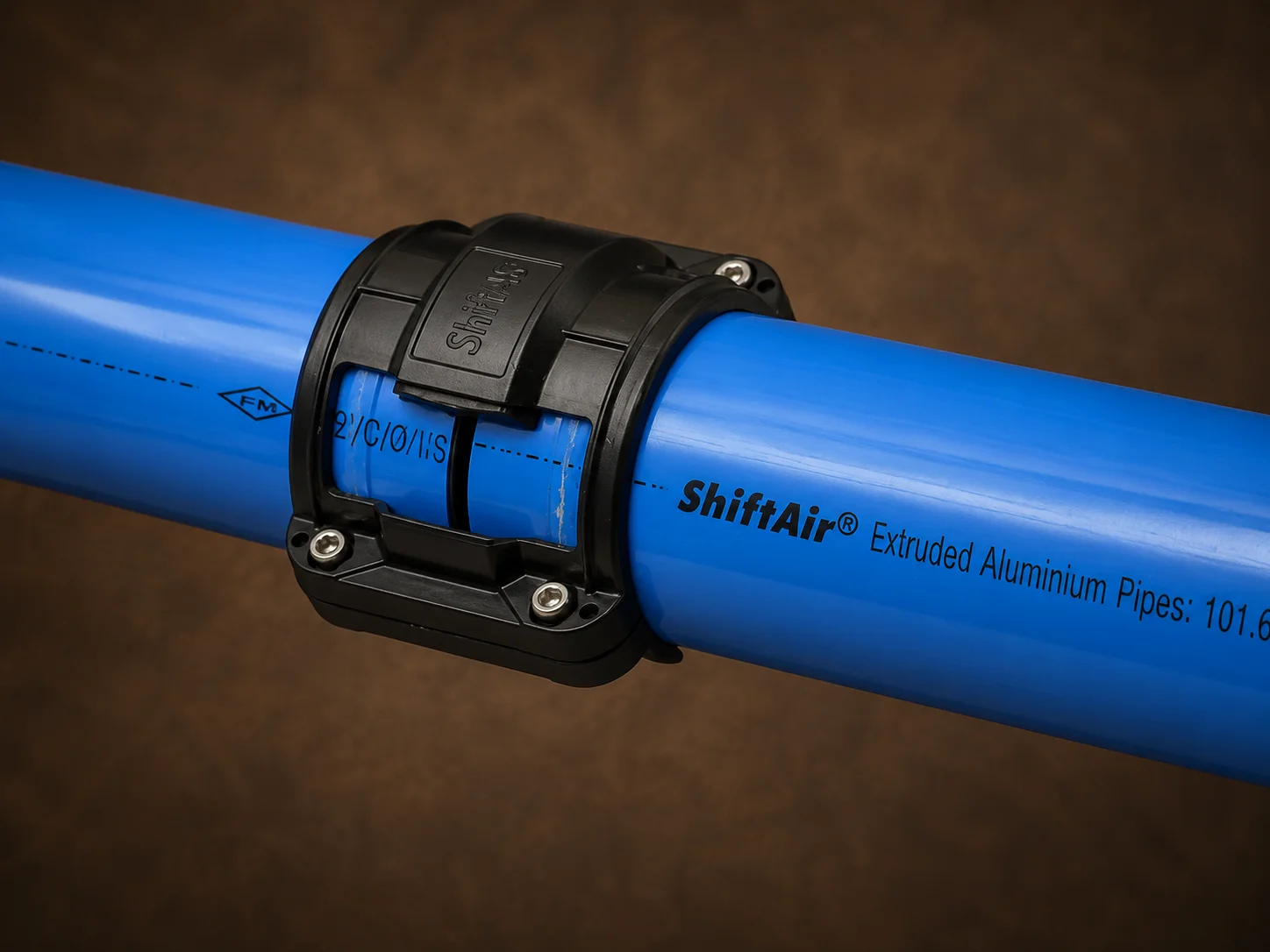
ShiftAir supplies modular aluminium compressed air piping, precision fittings, valves and mounting accessories for industrial air distribution. These systems are designed to provide corrosion resistance, organised routing, low pressure drop and easier future expansion.
Learn more about selecting a suitable industrial distribution partner in ShiftAir’s guide to choosing a compressed air piping system supplier .
ShiftAir also provides a pressure-drop calculator for preliminary network planning. Final pipe sizing should be based on actual airflow, operating pressure, pipe length, network layout, machine demand and expected future expansion.
Aluminium piping does not eliminate the need for inspection and preventive maintenance. Correct sizing, suitable supports, accessible isolation valves, minimal unnecessary bends and properly planned drop points remain essential.
However, a modular system can simplify production-line extensions and modifications while reducing corrosion-related maintenance associated with older iron-based networks. Additional information is available in ShiftAir’s guide to the benefits of aluminium compressed air pipes .
Turn Invisible Compressed Air Loss Into Measurable Savings
Compressed air leaks can cost a factory anywhere from a few thousand rupees to several lakhs of rupees per year. The most reliable calculation comes from measuring leakage flow, compressor specific power, annual pressurised hours and the factory’s actual electricity tariff.
As a practical benchmark, a poorly maintained compressed air network may lose approximately 20% to 30% of compressor output. A structured detection and repair programme should work towards controlling leakage within approximately 5% to 10% of total airflow.
A complete compressed air efficiency strategy should combine:
- Plant-wide leak detection
- Cost-based repair prioritisation
- Post-repair verification
- Compressor-control optimisation
- Appropriate operating pressure
- Correct pipe sizing and routing
- A reliable and maintainable distribution network
Planning or Improving a Compressed Air Piping Network?
ShiftAir Transmission supports industrial facilities with modular aluminium compressed air piping, precision fittings, valves, accessories and project-specific network guidance.
Share your compressor capacity, working pressure, approximate pipe length, layout and airflow requirements with the ShiftAir team to begin evaluating your compressed air distribution network.
Discuss Your Compressed Air ProjectFrequently Asked Questions
What Is an Acceptable Compressed Air Leakage Rate?
A well-maintained industrial compressed air system should generally keep leakage within approximately 5% to 10% of total compressed air flow. Leakage above 10% indicates a clear opportunity for improvement, while poorly maintained systems may lose 20% to 30% of compressor output.
How Do I Calculate the Annual Cost of Compressed Air Leaks?
Annual compressed air leak cost can be estimated by multiplying leakage flow by compressor specific power, annual pressurised operating hours and the factory’s electricity cost per kilowatt-hour.
Annual leak cost = Leakage flow × Specific power × Annual hours × Electricity rateDoes Lowering Compressed Air Pressure Reduce Leak Cost?
Yes. Lowering system pressure reduces the amount of air escaping through leaks. However, pressure should only be reduced after confirming the minimum pressure requirements of critical machines and correcting excessive pressure drop in the piping network.
Can a Small Compressed Air Leak Cost Lakhs of Rupees?
A single pinhole may not cost lakhs, but several medium-sized leaks or one larger opening can. For example, a 3.2 mm equivalent opening may cost more than ₹2 lakh annually when the line remains pressurised for 8,000 hours at an electricity rate of ₹10 per kWh.
How Often Should a Factory Inspect for Compressed Air Leaks?
Leak surveys should form part of preventive maintenance. Additional inspections should be conducted after machine relocations, piping modifications, unexplained pressure problems, unexpected compressor cycling or significant increases in electricity consumption.
Will Repairing Compressed Air Leaks Immediately Reduce the Electricity Bill?
Leak repairs reduce compressed air demand, but compressor setpoints, sequencing, unloaded running and operating schedules may also require adjustment before the full electricity saving appears on the factory’s energy bill.