
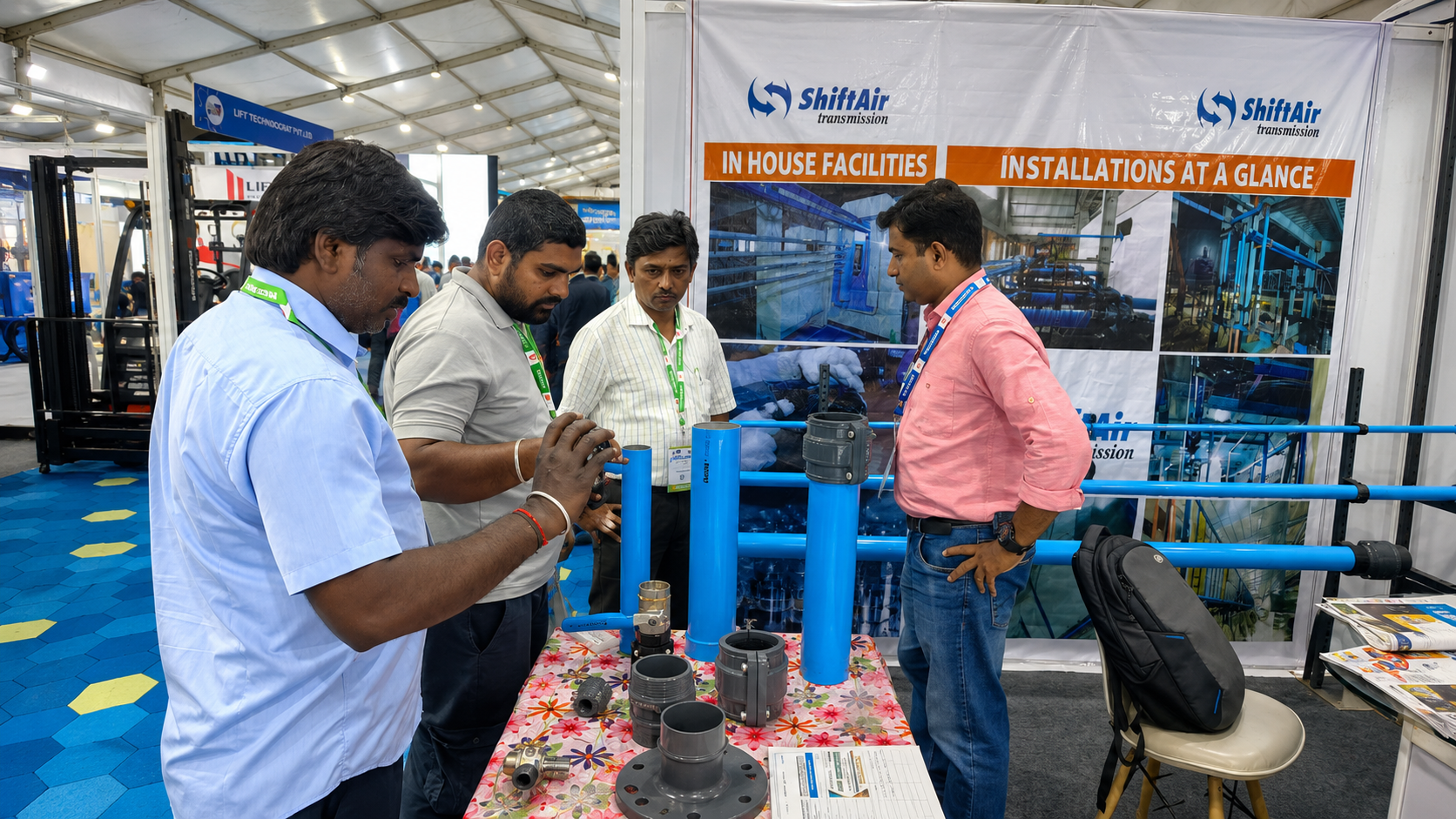
Industrial exhibitions are not just about setting up a booth, displaying products, and meeting visitors. They are about real conversations, new possibilities, industry learning, and building relationships that can shape the future of business. INTEC 2026 in Coimbatore was one such valuable experience for ShiftAir Transmission Pvt. Ltd. The event brought together professionals, manufacturers, engineers, consultants, business owners, and decision-makers from different industrial sectors. For ShiftAir Transmission Pvt. Ltd., it was an excellent platform to showcase its products, interact directly with customers, understand industry requirements, and explore new business opportunities. Coimbatore has always been recognized as one of India’s important industrial cities. With its strong presence in engineering, manufacturing, textiles, pumps, motors, machinery, and automation, the city provided the perfect setting for an exhibition like INTEC 2026. The event atmosphere was active, professional, and filled with energy. Every booth, every product display, and every discussion reflected the growing demand for reliable and innovative industrial solutions. At the ShiftAir Transmission Pvt. Ltd. booth, the response from visitors was truly encouraging. From the beginning of the exhibition, many industry professionals visited the stall to understand the products, discuss their requirements, and learn more about the company’s solutions. The booth became a space for meaningful technical conversations, where visitors could see the products closely and interact with the team directly. One of the most important highlights of the event was the quality of discussions. Visitors were not simply walking around casually; they were genuinely interested in understanding how the displayed products could be useful in their applications. They examined the pipes, fittings, valves, and installation-related components carefully. They asked questions about product quality, usage, durability, installation methods, and long-term performance. These kinds of direct interactions are extremely valuable in the industrial field. A brochure, catalogue, or online post can explain product details, but nothing can replace a face-to-face conversation. When customers can see the product, hold it, understand its design, and discuss their actual requirements with the team, it creates confidence and trust. INTEC 2026 gave ShiftAir Transmission Pvt. Ltd. exactly that opportunity. The product display at the booth played an important role in attracting visitors. The bright blue piping systems, industrial fittings, valves, and related components helped visitors clearly understand the company’s area of expertise. Instead of only explaining products through words, the team could demonstrate them practically. This made the discussions more effective and helped visitors connect the products with their real-time industrial needs. For ShiftAir Transmission Pvt. Ltd., the exhibition was also a great opportunity to listen. Every visitor came with a different requirement, challenge, or expectation. Some were looking for dependable product quality. Some wanted better installation support. Some were exploring suitable suppliers for upcoming projects. Others were interested in long-term business associations. These conversations helped the team understand the current needs of the market more closely. Events like INTEC are important because they bring the industry together under one roof. They create opportunities not only to present products but also to learn from customers, observe market trends, and understand what industries are expecting from solution providers. For ShiftAir Transmission Pvt. Ltd., the feedback received during the event was highly valuable and will help in improving customer support, product communication, and future business planning. Another major benefit of INTEC 2026 was networking. Industrial growth depends strongly on relationships, and exhibitions create the right environment for such connections. The ShiftAir team had the opportunity to meet new prospects, reconnect with existing contacts, interact with consultants, and build connections with professionals from different sectors. Every conversation opened a new possibility, whether in the form of a business enquiry, a project discussion, or a future partnership. The event also helped strengthen the brand presence of ShiftAir Transmission Pvt. Ltd. in the industrial market. A successful exhibition is not only about how many people visit the booth, but also about the impression the company leaves behind. Through active participation, clear communication, professional interaction, and a strong product display, the company was able to create a positive impact among visitors. The photographs from the event capture the true spirit of INTEC 2026. They show visitors gathered around the booth, discussing products, asking questions, and engaging with the team. These moments reflect what makes exhibitions meaningful. Behind every discussion, there is a real requirement. Behind every enquiry, there is a business possibility. Behind every handshake, there is a chance to build a long-term relationship. INTEC 2026 also reminded us that business is ultimately built on people. Products, systems, and technology are important, but trust and communication are equally important. When a company takes time to listen to customers, understand their concerns, and guide them with suitable solutions, it builds relationships that go beyond one-time transactions. For the ShiftAir team, the exhibition was more than just a marketing activity. It was a learning experience, a networking opportunity, and a moment to understand the pulse of the industry. The team returned from the event with valuable insights, promising enquiries, and stronger confidence in the growing demand for reliable industrial solutions. Another key takeaway from the event was the increasing need for dependable and application-focused products. Today, industries are looking for partners who can offer quality, consistency, technical understanding, and timely support. Customers want solutions that are practical, durable, and suitable for their specific requirements. ShiftAir Transmission Pvt. Ltd. used INTEC 2026 as a platform to communicate its commitment to these values. The success of the event would not have been possible without the visitors, customers, industry professionals, and well-wishers who took the time to visit the booth and interact with the team. Their interest, questions, feedback, and support made the exhibition truly meaningful. Every discussion added value, every enquiry brought a new opportunity, and every interaction helped build stronger industry connections. Overall, INTEC 2026 at Coimbatore was a successful and memorable exhibition for ShiftAir Transmission Pvt. Ltd. It provided the company with a strong platform to showcase its products, connect with industry professionals, understand customer expectations, and explore exciting business opportunities. As ShiftAir Transmission Pvt. Ltd.
What Is a Compressed Air Piping System and Why Does It Matter in Modern Factories?
In most factories, compressed air is used every single day. It may be running pneumatic tools, packaging machines, cylinders, valves, cleaning lines, automation equipment, or production machines. Because it is so common, many teams treat compressed air like a normal utility. But there is one part of the system that is often ignored: the compressed air piping system. Many factories invest in a good compressor, but still face low pressure at the machine end. The compressor keeps running, electricity bills increase, and the production team keeps asking why the machines are not getting proper air. In many cases, the issue is not the compressor. The real problem is the piping layout, pipe material, leakage, bends, fittings, or pressure drop inside the air line. A well-planned compressed air piping system helps compressed air move smoothly from the compressor room to every machine point. A poor system wastes energy, reduces pressure, increases maintenance problems, and affects production output. For plant heads, maintenance managers, project engineers, and factory owners, understanding compressed air piping is important before installing a new line or upgrading an old one. What Is a Compressed Air Piping System? A compressed air piping system is the network of pipes, tubes, connectors, elbows, valves, and fittings that carries compressed air from the compressor to different machines and workstations inside a factory. The compressor produces the air pressure, but the piping system decides how efficiently that pressure reaches the point of use. A basic compressed air distribution system usually starts from the compressor room. The compressed air passes through an air receiver, dryer, filters, and then enters the main piping line. From there, it moves through branch lines and drop points to reach machines on the shop floor. In simple words, the compressor is the source, and the piping system is the route. If the route is not properly designed, the air will not reach the machines with the right pressure and flow. A good compressed air piping system should help the factory get: Stable air pressure at machine points Lower pressure drop Less air leakage Cleaner and drier air supply Better energy efficiency Easier maintenance Easy expansion when new machines are added This is why compressed air piping should not be planned at the last minute. It should be treated as an important plant utility. Main Components of a Compressed Air Piping System A proper industrial compressed air piping setup includes several parts. Each part plays a role in maintaining pressure, air quality, and reliability. Air Compressor The air compressor is the heart of the system. It compresses atmospheric air and supplies it at the required pressure. However, even the best compressor cannot perform well if the air compressor pipe line is poorly designed. If the pipe size is too small, the layout is too long, or there are too many bends, the compressor will work harder but the machine may still receive low pressure. Air Receiver Tank The air receiver tank stores compressed air and helps manage sudden changes in air demand. For example, when multiple machines start using air at the same time, the receiver helps maintain a more stable supply. It also reduces frequent loading and unloading of the compressor. Air Dryer and Filters Compressed air usually contains moisture, dust, oil particles, and other impurities. If this air goes directly into the pipe line, it can damage machines, tools, valves, and pneumatic parts. Dryers and filters help clean the air before it enters the compressed air piping system. This is especially important in industries like food processing, packaging, pharmaceuticals, electronics, printing, and automation. Main Header Line The main header line is the primary pipe that carries compressed air from the compressor room to the production area. This line must be sized properly because it handles the major air flow of the plant. If the main line is undersized, the entire factory may face pressure drop issues. Branch Lines Branch lines carry air from the main header to different departments, machines, or workstations. These lines should be planned according to machine locations and air demand. Random branch connections can create uneven pressure in different areas of the factory. Drop Lines Drop lines bring air from the overhead or main pipe line down to the machine connection point. These lines should be installed carefully so that moisture and dirt do not easily enter the machine. Good drop line planning improves both air quality and machine safety. Connectors, Elbows, Valves, and Fittings Connectors, elbows, valves, and fittings are small parts, but they have a big impact on the system. Poor-quality fittings can create leakage. Too many elbows can create resistance. Incorrect valves can make maintenance difficult. Using good-quality connectors, elbows, and valves helps keep the compressed air distribution system reliable and easy to service. Where Factories Use Compressed Air Piping Compressed air is used in many industries because it is flexible, safe, and suitable for different factory operations. A good industrial compressed air piping system is commonly used in: Automotive component factories Textile and garment units Food and beverage plants Packaging factories Pharmaceutical production units Plastic molding factories Electronics manufacturing Metal fabrication workshops Printing and paper industries General engineering plants In these factories, compressed air may be used for pneumatic cylinders, air tools, spray systems, cleaning, machine operation, control valves, automation equipment, and material handling. For example, in a packaging factory, compressed air may be used for sealing, cutting, labeling, filling, and moving products. If the pressure drops during production, the machine may slow down, reject products, or stop completely. In a fabrication workshop, low air pressure can affect tool performance. In an automation line, unstable pressure can disturb timing and movement. In a food or pharma plant, poor air quality can create serious process issues. This is why compressed air piping is not just a supporting system. It directly affects production speed, product quality, and machine uptime. Why Pipe Material Matters The material used in a compressed air piping system affects air flow, durability, installation time, maintenance, and long-term
Why Current Industries Are Switching to Modular Aluminium Piping Systems
Compressed air is one of the most important utilities in modern manufacturing. Whether it is used for running pneumatic tools, automation systems, packaging lines, or CNC machinery, a reliable compressed air network is critical for smooth and efficient operations. Many companies invest heavily in high-performance air compressors but often overlook the infrastructure responsible for distributing compressed air throughout the facility. However, even the best compressor cannot operate efficiently if the piping system experiences pressure loss, air leakage, or airflow restrictions. This is why many Indian industries are switching from traditional GI and steel pipelines to aluminium compressed air piping systems, which offer improved airflow, reduced maintenance, faster installation, and significant energy savings. In fact, aluminium piping can reduce pressure drop by up to 30 per cent compared to conventional steel systems, delivering overall energy cost reductions of 15 to 25 per cent. Some facilities have reported saving 5 to 8 lakh rupees annually on electricity bills after converting to aluminium piping, making the investment quick to recover. Manufacturers striving for greater productivity and lower operating costs are increasingly adopting aluminium compressed air piping systems as a key component of modern industrial infrastructure. One often-overlooked function of a compressed air piping system is its role in overall system efficiency. Much of the discussion surrounding compressed air equipment focuses on compressors, dryers, and filtration systems. However, the piping network is equally important in determining overall system performance. Think of the piping system as a highway that carries compressed air from the compressor room to various production areas. If that highway is poorly designed, congested, or damaged, the entire system becomes inefficient. Some of the common problems caused by poorly designed piping networks include: Pressure loss Air leaks Non-uniform flow distribution Increased compressor load Higher electricity consumption These issues directly impact productivity, production efficiency, and operating costs. A well-designed compressed air distribution system ensures that every machine receives the air pressure it requires while minimizing energy loss throughout the network. Why Traditional Steel and GI Pipes Are Becoming Obsolete GI and steel pipes have been widely used in industrial compressed air systems for decades. While they have served their purpose, modern manufacturing environments demand greater efficiency, reliability, and flexibility. One of the biggest disadvantages of steel pipelines is internal corrosion. Rust buildup inside the pipe restricts airflow and increases pressure losses. The rough internal surface creates additional resistance, forcing compressors to work harder to maintain the desired operating pressure. Rust contamination can also negatively affect air quality, which is a major concern for industries such as pharmaceuticals, food processing, electronics manufacturing, and precision engineering. In addition, steel pipelines require welding, threading, and extensive maintenance, making future modifications expensive and time-consuming. These limitations have encouraged industries to seek more efficient alternatives. Aluminium is transforming industrial air distribution across India by providing a competitive advantage that traditional piping systems cannot match. Aluminium has become one of the most effective materials for compressed air distribution systems. Unlike steel, aluminium does not rust internally, keeping the airflow path clean and smooth throughout the system’s lifespan. This results in lower pressure drops, higher efficiency, and improved equipment performance. Another major advantage is its lightweight construction. Aluminium pipes are significantly lighter than steel pipes, making them easier to transport, handle, and install. Most aluminium piping systems utilize simple mechanical fittings such as push-to-connect or clamp joints, eliminating the need for skilled welders or specialized tools. Typical installation involves measuring and cutting the pipe, assembling sections using connectors, and securing the system with basic supports. This straightforward process allows maintenance teams to complete installations, modifications, and future expansions quickly and efficiently. For industrial facilities, these advantages translate into: Faster installation Reduced labour costs Lower structural loading Easier future expansion These practical benefits, combined with energy savings and reduced maintenance requirements, make aluminium piping an attractive solution for manufacturers seeking greater efficiency. How Pressure Drop Affects Energy Costs Pressure losses within compressed air networks often result in significant energy waste that goes unnoticed. Pressure drop refers to the loss of compressed air pressure as it travels through the piping system. Common causes include: Rusted pipes Poor network design Excessive bends and curves Undersized piping Air leakage Many facilities compensate for pressure loss by increasing compressor pressure settings. While this may solve the immediate problem, it also increases energy consumption and operating expenses. To avoid unnecessary costs and maintain optimal efficiency, facilities should regularly monitor system pressure at key points throughout the network. Periodic pressure audits using portable gauges or digital monitoring tools can quickly identify hidden losses before they result in higher energy bills. Installing permanent pressure monitoring devices allows continuous tracking, enabling maintenance teams to detect and address issues before they become major problems. A well-designed aluminium piping system promotes smooth airflow and minimizes pressure drops, improving compressor efficiency and reducing electricity consumption. Significance of Leak-Free Air Distribution Air leakage is one of the most common causes of energy loss in industrial facilities. Even small leaks can accumulate over time, leading to substantial energy waste. Many plants lose a significant portion of their compressed air due to leaking joints, damaged fittings, and aging pipeline infrastructure. Modern aluminium piping systems use advanced connection technologies specifically engineered to minimize leaks, improving system reliability and reducing wasted energy. Reducing air loss helps industries: Increase compressor efficiency Lower electricity bills Improve equipment performance Reduce maintenance requirements Preventing leaks is one of the simplest and most effective ways to maximize the return on investment from a compressed air system. How Modular Piping Systems Support Future Growth Industrial plants are constantly evolving. New production lines, additional machinery, and process upgrades often require changes to the compressed air network. With traditional steel piping systems, these modifications can be expensive and disruptive. Aluminium piping systems are purpose-built for flexibility. Their modular design allows companies to expand, relocate, or modify air distribution networks quickly while minimizing downtime. For example, a leading auto component manufacturer in Pune recently upgraded from steel to aluminium piping to support a new production