
Many factories continue operating compressed air distribution systems that were installed years or even decades ago. In many cases, these systems use galvanised iron, commonly called GI, with threaded joints, multiple repaired sections and production branches added gradually over time.
An old GI network may still appear serviceable from the outside. However, internal corrosion, scale, restricted pipe diameter, ageing joints and repeated modifications can increase pressure loss and leakage. Maintenance teams may repair one section only to discover another leak a few weeks later.
At this point, factory managers face an important decision: should they continue repairing the existing GI compressed air network, or invest in a new aluminium compressed air piping system?
The answer cannot be based only on the cost of pipe and fittings. A proper comparison should include electricity consumption, pressure stability, leak frequency, production downtime, air quality, maintenance labour and future expansion.
This guide compares both options and explains when repairing GI may still be reasonable and when a new aluminium network may provide better long-term value.
Why Old GI Compressed Air Networks Become Expensive
GI piping was widely used in industrial compressed air systems because it was available, familiar to installers and mechanically strong. A correctly designed and maintained GI network can operate for many years. Problems usually develop as the system ages, especially where moisture is present and the network has been modified repeatedly.
Compressed air contains water vapour. As the air cools, this vapour may condense inside pipes. Air dryers, moisture separators and automatic drains reduce the amount of water entering the distribution system, but older installations may have inadequate treatment, failed drains or poorly arranged pipe slopes.
Moisture can contribute to internal corrosion. Over time, corrosion products and scale may create a rough internal surface. This increases resistance to airflow and can reduce the effective internal diameter of the pipe.
The network may also contain old threaded joints, sealants, reducers and repaired sections. Every additional fitting introduces another potential leak point and another restriction.
Common signs of an ageing GI compressed air network include:
- Recurring leaks at threaded connections
- Visible rust around joints and low points
- Pressure loss at distant machines
- Rust particles in filters or equipment
- Frequent pipe patching and section replacement
- Multiple unused branches left pressurised
- Different pipe sizes added without a system plan
- Production areas supplied through long temporary hoses
- Increasing compressor pressure to maintain machine performance
A Working Pipe Is Not Always an Efficient Pipe
An old GI pipe may still hold pressure, but that does not mean it is delivering air efficiently. Internal restrictions, leakage and pressure drop can increase operating costs without causing an obvious pipe failure.
What Is an Aluminium Compressed Air Network?
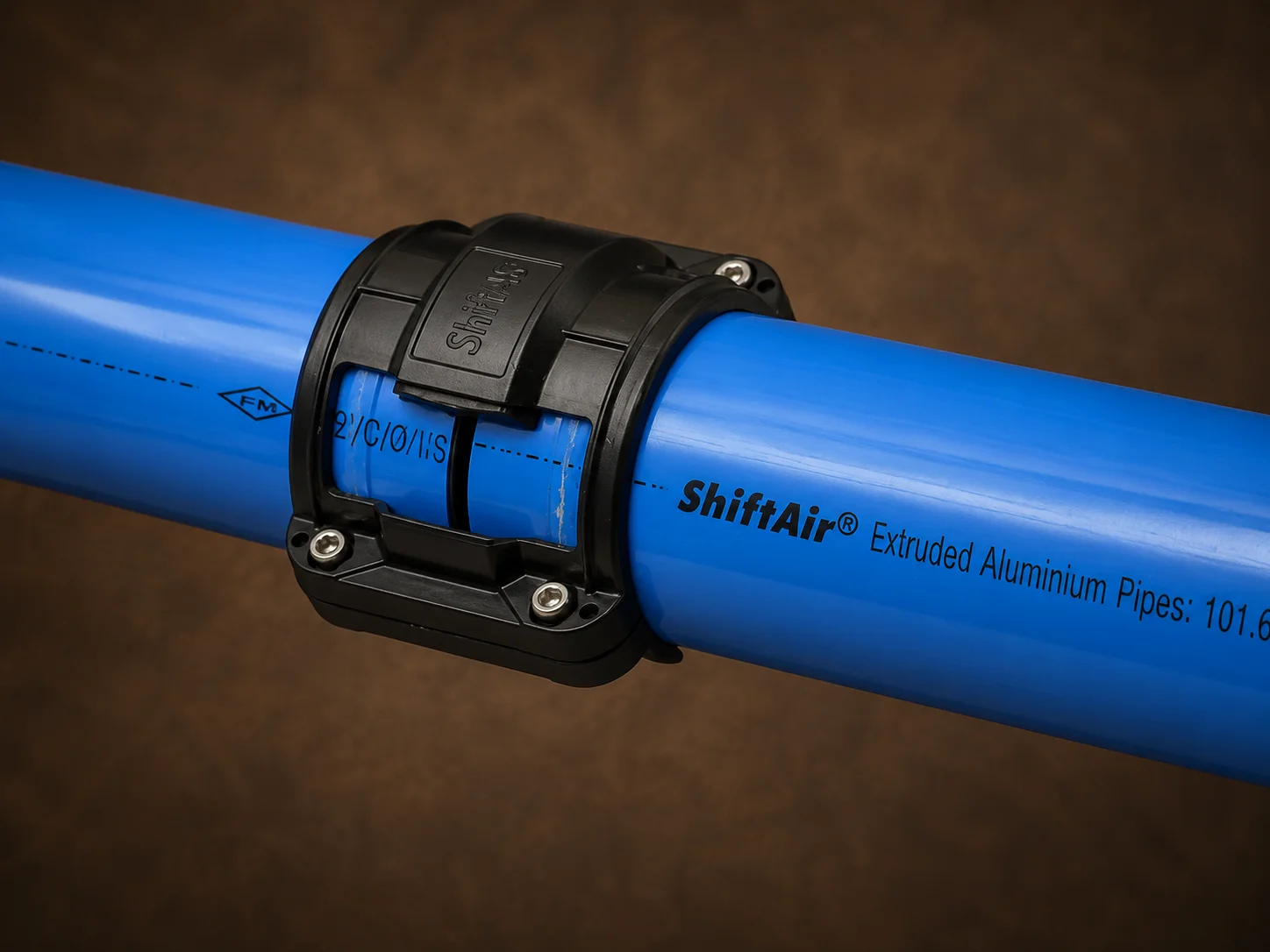
An aluminium compressed air network uses lightweight, corrosion-resistant aluminium pipes with modular fittings designed specifically for compressed air distribution.
Depending on the product system, the installation may use compression, push-fit or mechanically secured fittings. The pipe is typically cut to length, deburred, inserted into the fitting and secured according to the manufacturer’s instructions.
Aluminium systems are often installed as organised ring mains with clearly planned branches, isolation valves, drops and future expansion points.
Typical benefits include:
- Smooth internal pipe surface
- Resistance to internal rust
- Lower weight than traditional steel piping
- Faster cutting and assembly
- Cleaner installation without extensive threading
- Convenient modification and expansion
- Professional appearance and easier line identification
- Reduced need for painting in many environments
Aluminium piping is not automatically efficient simply because of the material. The network must still be correctly sized, routed, supported, drained and commissioned.
GI vs Aluminium Compressed Air Piping: Key Differences
| Factor | Old GI Network | New Aluminium Network |
|---|---|---|
| Internal corrosion | May increase with age, moisture and poor drainage | Aluminium is resistant to internal rust |
| Internal surface | May become rough due to corrosion and scale | Smooth internal bore supports efficient airflow |
| Pipe weight | Heavy and labour-intensive to handle | Lightweight and easier to position |
| Joint type | Often threaded, sealed or welded in sections | Modular fittings designed for faster assembly |
| Leak risk | Can increase as joints age and vibration affects connections | Can be lower when installed correctly and inspected regularly |
| Installation speed | Cutting, threading and heavy handling can take longer | Cutting and modular assembly can reduce installation time |
| Maintenance | May require repeated repairs, painting and section replacement | Generally lower maintenance, with periodic inspection still required |
| Expansion | Can require threading, welding or extensive shutdowns | Usually easier to extend with compatible modular components |
| Air cleanliness | Rust particles may affect filters and equipment | No internal rust from the aluminium pipe itself |
| Initial cost | Local repair may appear inexpensive | Full replacement requires higher initial investment |
| Lifetime value | Can become expensive if leaks and repairs continue | May provide better value through reduced maintenance and pressure loss |
Initial Cost vs Lifetime Cost
Repairing an old GI pipe usually has a lower immediate cost than replacing an entire compressed air network. A factory may repair a leaking tee, replace a damaged section or reseal several joints without making a large capital investment.
The problem arises when the repair is treated as a permanent solution even though deterioration is spread across the network.
A low-cost repair may restore pressure temporarily, but the factory may continue paying for leakage, pressure drop, maintenance labour, production stoppages and higher compressor pressure.
A new aluminium compressed air network requires a higher initial investment. However, the comparison should be made using total lifecycle cost rather than purchase price alone.
The lifecycle comparison should include:
- Pipe and fitting cost
- Installation labour
- Production downtime
- Electricity used by compressors
- Leak-repair expenses
- Maintenance labour
- Replacement of filters and pneumatic components
- Cost of future extensions
- Impact of unstable pressure on production
- Cost of unplanned shutdowns
Key decision principle: Repairing one isolated defect is different from continuously repairing an ageing system. Once repair costs become recurring, replacement should be evaluated as an operating-cost project rather than only a piping purchase.
Pressure Drop and Compressor Energy Use
Pressure drop is one of the most important differences between an ageing GI network and a correctly designed aluminium system.
As a GI pipe corrodes internally, its surface becomes rougher. Scale and deposits can also reduce the effective diameter. Airflow then meets greater resistance, particularly across long pipe runs and during peak production demand.
Factories often respond by increasing the compressor discharge pressure. This may restore pressure at distant machines, but it causes the entire system to operate at a higher pressure than necessary.
Higher pressure can increase compressor power demand and may also increase leakage through existing openings. The factory therefore pays more to produce additional compressed air, while part of that air continues escaping through leaks.
A new aluminium system can reduce unnecessary pressure loss when it is designed with:
- Correct main and branch pipe sizes
- A smooth internal bore
- A ring-main layout where appropriate
- Fewer unnecessary bends and restrictions
- Full-bore valves and suitable fittings
- Shorter, correctly sized point-of-use connections
- Proper air treatment and drainage
The aluminium material itself is only one part of the improvement. Much of the benefit comes from redesigning the network around measured airflow, pressure requirements and future demand.
Do Not Compare Pressure Only at the Compressor
Pressure should be measured at the compressor room, after air-treatment equipment, along the main line and at critical machines during actual production. These measurements reveal where pressure is being lost.
Corrosion and Compressed Air Quality
Internal corrosion is more than a pipe-maintenance issue. Rust and scale can travel through the compressed air network and collect in filters, valves, cylinders, regulators and production equipment.
In general manufacturing, contamination may increase component wear and maintenance frequency. In sensitive applications, such as food processing, pharmaceutical manufacturing, electronics, painting and instrumentation, poor air quality can affect process reliability and product quality.
A new aluminium network does not create iron rust internally. This can help support cleaner compressed air distribution after appropriate compressors, dryers, filters and separators have treated the air.
It is important to note that aluminium piping does not replace air treatment. Oil, moisture, particles and other contamination must still be managed according to the application’s air-quality requirements.
If rust contamination is already widespread in an old GI system, replacing only one short section may not solve the problem. The remaining network can continue releasing particles.
Replacement Becomes More Relevant When:
- Rust particles repeatedly appear in point-of-use filters
- Moisture has damaged large areas of the network
- Pneumatic equipment fails prematurely
- Air cleanliness is critical to production
- Internal pipe condition cannot be restored economically
Leakage and Joint Reliability
Compressed air leaks can occur in any system, including a new aluminium installation. However, ageing GI networks often contain a high number of threaded joints, reducers, repairs and branch additions.
Threaded joints may leak because of sealant deterioration, corrosion, vibration, mechanical stress or repeated disassembly. Repairing one joint may disturb another nearby connection.
In older factories, maintenance teams sometimes install temporary hoses or additional threaded fittings to avoid a full shutdown. These temporary solutions can remain in service for years and add more leak points.
A modular aluminium network can reduce reliance on traditional threaded joints. Fittings designed specifically for the pipe system can support reliable connections when installed, supported and commissioned correctly.
However, no piping system should be considered permanently leak-free. Factories should maintain a regular leak-detection programme and inspect:
- Pipe joints
- Valves
- Automatic drains
- Flexible hoses
- Quick couplings
- Regulators
- Machine connections
- Unused branches
Replacing the main piping while leaving leaking hoses and machine connections unchanged will not deliver the full expected benefit.
Installation Time and Production Disruption
GI installation can require cutting, threading, sealing, heavy lifting, alignment and painting. Existing sections may also need to be removed before new pipes are installed.
Aluminium pipes are lighter and can generally be assembled faster using modular fittings. This can reduce the amount of hot work, heavy handling and on-site fabrication required.
Faster installation is particularly valuable in operating factories where production downtime is expensive. A well-planned project may allow the new aluminium ring main to be installed alongside the existing network while production continues.
Final connections can then be completed during planned shutdown windows, weekends or non-production shifts.
Installation planning should consider:
- Production shutdown availability
- Pipe routes above machines and walkways
- Working-at-height requirements
- Existing cable trays and utility lines
- Future machine positions
- Isolation and temporary air supply
- Safe removal of old piping
- Testing and commissioning time
Practical advantage: In many projects, the new aluminium network can be installed before the old GI network is disconnected. This may help reduce production interruption.
Long-Term Maintenance Requirements
An old GI network may require repeated joint sealing, pipe replacement, rust treatment, painting and drain maintenance. As the system ages, maintenance can become reactive rather than preventive.
Maintenance teams may know which joints leak frequently, but temporary repairs continue because replacing the complete network is treated as a capital project.
A new aluminium network can reduce several of these maintenance demands. The pipe does not require internal rust removal, and modular fittings can simplify future branch additions.
Aluminium piping still requires inspection. Supports can loosen, valves can fail, fittings can be damaged and external impacts can affect the network.
A practical maintenance programme should include:
- Regular leak surveys
- Visual checks of joints and supports
- Drain inspection
- Valve operation checks
- Pressure measurement at critical points
- Review of unused branches
- Inspection after machine relocation
- Repair documentation and system drawings
The main difference is that maintenance can focus on system performance rather than repeatedly correcting corrosion-related failures.
Expansion and Factory Layout Changes
Production layouts rarely remain unchanged. Factories add machines, shift assembly lines, expand departments and introduce new pneumatic processes.
Old GI networks are often difficult to modify because adding a branch may require cutting and threading heavy pipe. The nearest existing connection may also be undersized or located in the wrong position.
As a result, expansion is sometimes completed using long hoses, small branches or multiple adapters. These additions increase restriction and make the network harder to maintain.
Modular aluminium piping is better suited to facilities that expect regular layout changes. New branches, drops, valves and extensions can often be added with less disruption.
A new network should not only meet current demand. It should include:
- Capacity for reasonable production growth
- Strategic isolation valves
- Planned future connection points
- Space for additional air treatment
- Flexible routing around future equipment
- A ring-main arrangement where suitable
- Updated drawings for maintenance teams
When Repairing the Existing GI Network Still Makes Sense
Replacing GI piping is not automatically the correct answer for every factory. Repair may be practical when the problem is isolated and the remaining network is in good condition.
Repairing GI may be reasonable when:
- The network is relatively new
- Internal corrosion is minimal
- Pressure drop remains within an acceptable range
- Leaks are limited to one or two identifiable locations
- The main pipe size is suitable for current and future demand
- Air quality is not being affected by rust contamination
- The system has an organised ring or main-line layout
- No major factory expansion is planned
- The repair can be completed safely and permanently
In this situation, replacing a damaged valve, fitting, drop or short pipe section may be the most economical solution.
The repair should still be followed by leak testing and pressure measurements. Otherwise, the visible defect may be corrected while other restrictions remain unidentified.
When a New Aluminium Network Is the Better Choice
Replacement becomes more attractive when problems are distributed across the entire GI network rather than concentrated in one location.
A new aluminium system should be evaluated when:
- Leaks return frequently after repairs
- Many threaded joints are corroded or damaged
- Pressure at machines falls during peak demand
- The compressor is operating at higher pressure to compensate
- Rust particles are affecting filters or equipment
- The network has multiple temporary modifications
- Existing mains are undersized
- Repair work causes repeated production shutdowns
- The factory is planning expansion or equipment relocation
- Maintenance costs are increasing every year
- The original network layout is no longer suitable for production
In these cases, continued repair may only delay replacement while operating costs continue.
Repair the Defect or Redesign the System?
When the pipe material is still sound and the problem is local, repair the defect. When pressure loss, leakage, corrosion and poor layout affect multiple areas, redesigning the distribution system may provide better long-term value.
Can an Old GI Network Be Replaced in Phases?
Yes. A factory does not always need to replace every metre of GI piping in one project.
A phased replacement strategy can prioritise the areas with the highest pressure loss, most frequent leaks or greatest production importance.
Common phased approaches include:
- Replacing the compressor room header and main distribution ring
- Upgrading the most distant or pressure-sensitive production area
- Replacing high-leak sections during planned shutdowns
- Installing new aluminium branches for new machines
- Gradually disconnecting unused GI sections
Suitable transition fittings can connect the new aluminium system to parts of the existing GI network. The remaining GI sections should still be inspected and leak tested because their problems can affect the performance of the new system.
A phased project should have a final network plan. Without a master design, individual upgrades may create another collection of disconnected pipe sizes and inefficient routes.
Practical Cost-Comparison Example
Consider a factory operating a three-shift production schedule with an ageing GI compressed air network. The system contains several hundred metres of piping, multiple threaded branches and repeated repairs.
The factory experiences:
- Pressure loss at the furthest production line
- Regular leakage around threaded joints
- Rust particles in point-of-use filters
- Several maintenance shutdowns each year
- Plans to add new machines within two years
Option 1: Continue Repairing the GI Network
The factory can repair the most visible leaks and replace the worst sections. This requires less immediate capital, but it does not correct the undersized main, internal corrosion or poor network layout.
Annual costs may continue to include:
- Maintenance labour
- Replacement valves and fittings
- Production downtime
- Compressed air lost through remaining leaks
- Additional compressor energy caused by pressure drop
- Future modifications for new machines
Option 2: Install a New Aluminium Ring Main
The factory installs a correctly sized aluminium ring around the production area, adds strategic isolation valves and provides new drops to critical machines.
The initial cost is higher, but the project addresses the causes of the problem rather than repairing individual symptoms.
Potential long-term benefits include:
- More stable pressure at production machines
- Lower leakage from the main distribution network
- Reduced corrosion-related contamination
- Fewer maintenance shutdowns
- Easier connection of future machines
- Potential reduction in unnecessary compressor pressure
The actual financial return depends on measured leak levels, compressor energy use, pressure requirements, production downtime and project cost. A site survey is therefore more reliable than using a general percentage-saving claim.
Factory Evaluation Checklist
Before deciding between repair and replacement, collect the following information:
- Age of the existing GI network
- Total pipe length and pipe sizes
- Number and location of recurring leaks
- Pressure at the compressor room
- Pressure at critical machines during peak demand
- Condition of internal and external pipe surfaces
- Frequency and cost of repairs
- Production downtime caused by pipe maintenance
- Evidence of rust or moisture contamination
- Compressor discharge pressure and operating hours
- Planned machine additions or plant expansion
- Condition of dryers, filters and drains
- Airflow demand of major production equipment
- Unused branches that remain pressurised
- Accessibility of isolation valves
This information helps identify whether the factory has a local pipe defect or a system-wide distribution problem.
New Aluminium Network or GI Repair: Which Option Saves More?
Repairing an old GI compressed air network saves more money when the system is fundamentally sound and the problem is limited to a small number of damaged components.
A new aluminium network is more likely to provide better long-term value when corrosion, leakage, pressure drop, contamination and poor layout affect large parts of the system.
The final decision should not be based on pipe price alone. A factory should compare the cost of continued energy loss, repeated repairs, production disruption and future expansion with the cost of a properly designed replacement.
In many cases, the most practical solution is a phased upgrade. The factory can install a new aluminium main ring or replace the most problematic production area first, then continue the upgrade during future shutdowns.
The objective should be to create a compressed air distribution system that delivers the required pressure with minimum leakage, contamination and maintenance.
Learn more about the benefits of aluminium compressed air pipes and review common compressed air piping installation mistakes before planning a new network.
Need Help Evaluating Your Existing GI Network?
ShiftAir Transmission supplies modular aluminium compressed air piping, fittings, valves and accessories for industrial air-distribution projects.
Share your current pipe sizes, compressor capacity, working pressure, factory layout, recurring leak areas and expansion plans with the ShiftAir team. This information can help determine whether targeted repairs, phased replacement or a complete new network is the most practical approach.
Discuss Your Compressed Air NetworkFrequently Asked Questions
Is Aluminium Compressed Air Piping Better Than GI Piping?
Aluminium piping is often preferred for modern compressed air networks because it is corrosion-resistant, lightweight, smooth internally and easier to modify. However, the correct choice depends on pressure, airflow, operating environment, budget and future expansion plans.
Should an Old GI Compressed Air Network Be Repaired or Replaced?
Repair may be suitable when damage is localised and the rest of the network remains structurally sound. Replacement may be more economical when leaks, corrosion, pressure drop, contamination and maintenance problems are spread throughout the system.
Can Aluminium Compressed Air Piping Reduce Pressure Drop?
A correctly sized aluminium network can help reduce pressure drop because it has a smooth internal surface and can be installed using an efficient layout. Actual performance depends on airflow, pipe size, total equivalent length, fittings and point-of-use restrictions.
Can a GI Compressed Air System Be Replaced in Stages?
Yes. Many factories replace the compressor room header, main ring or most problematic production areas first. New aluminium sections can be connected to the remaining GI network using suitable transition fittings.
Does Aluminium Compressed Air Piping Require Maintenance?
Aluminium piping generally requires less maintenance than an ageing threaded GI network, but it should still be inspected for leaks, support condition, impact damage, valve operation and correct drainage.
How Can a Factory Know Whether Pipe Replacement Will Save Money?
Compare repair frequency, leak levels, pressure loss, compressor power, production downtime, air-quality problems and future expansion costs. Pressure and airflow measurements provide a more reliable decision than comparing pipe prices alone.