
The Plant Engineer’s 2026 Guide to Choosing a Compressed Air Piping System Supplier in India
Why the Piping Network—Not the Compressor—Often Decides Your Energy Bill
Most Indian plant teams spend weeks evaluating compressors and minutes approving the piping. That imbalance is expensive. Compressed air is one of the most inefficient utilities in a factory—typically less than 20% of the energy input reaches the point of use—and the piping network is where the waste compounds.
A compressed air piping system supplier who treats the network as a commodity will hand you a system that leaks, corrodes, and forces your compressor to run harder than it should for the next fifteen years.
Industry Benchmark: Studies consistently show that 25–30% of compressed air generated in a typical Indian factory is lost to leaks, and compressed air accounts for up to 30% of total industrial electricity consumption. Ageing GI (galvanised iron) or MS (mild steel) networks suffer leakage rates estimated at 20–35%; replacing them with modular aluminium systems can deliver 15–25% energy savings.
This guide gives you the technical numbers: pressure-drop limits, velocity targets, material specifications, IS 6206 requirements, and the specific engineering parameters you should demand from any compressed air distribution system manufacturer—including the published specifications of India-built modular systems such as ShiftAir. Use it to evaluate industrial compressed air pipe suppliers on engineering competence, not brochure language.
The Engineering Numbers Your Compressed Air Pipework Supplier Should Put on the Table Before You Sign
A compressed air pipework supplier who cannot produce four calculations does not deserve the order. Here is what the engineering should look like before any material is quoted.
1. Pressure Drop: The Real Budget Is 0.3 Bar, Not “Whatever the Compressor Can Push”
The commonly cited design ceiling for pressure drop across a compressed air network is 0.3 bar (approximately 4.5 psi) from the compressor discharge to the furthest point of use. Some Indian design guides allow up to 0.5 bar, but that upper limit should be treated as a failure threshold, not a target.
Why does this matter financially? Every additional bar of compressor discharge pressure consumes 6–8% more electricity. If a compressed air piping system supplier designs a network with a 1.5 bar drop—common in corroded GI systems—the compressor must run at 8.5 bar to deliver 7 bar at the machine. That is a permanent energy penalty built into the pipe.
A competent compressed air pipework supplier will survey demand points, pipe length, branches, operating pressure, acceptable pressure drop, and future machine additions before recommending a diameter. Pipe sizing based only on “what was there before” or “what fits the compressor outlet” is a recipe for chronic pressure drop. ShiftAir’s own technical approach specifies layout optimisation “for minimal bends, proper slope, and calculated pressure drop using software-based simulations”. That is the standard to demand.
2. Velocity: Keep Mains Below 6 m/s, Not 20
A competent compressed air ring main supplier will size the main header to keep air velocity at or below 6 m/s. Branch lines can run higher—up to 20 m/s in short drops—but sustained high velocity in mains causes friction loss and prevents condensate from separating out.
This is where many Indian quotations fail. A supplier who sizes pipe diameter by matching the compressor outlet flange, rather than by calculating velocity at peak demand, will deliver a system that “works” on day one and underperforms at full production load.
3. Leakage: The Benchmark Is 8–10%, Not 30%
A well-maintained compressed air network should leak less than 8–10% of generated air. Indian plants running ageing GI or MS networks routinely leak 20–35%. A compressed air distribution system manufacturer should state the leakage target their system is designed to achieve and explain how the jointing method supports that target.
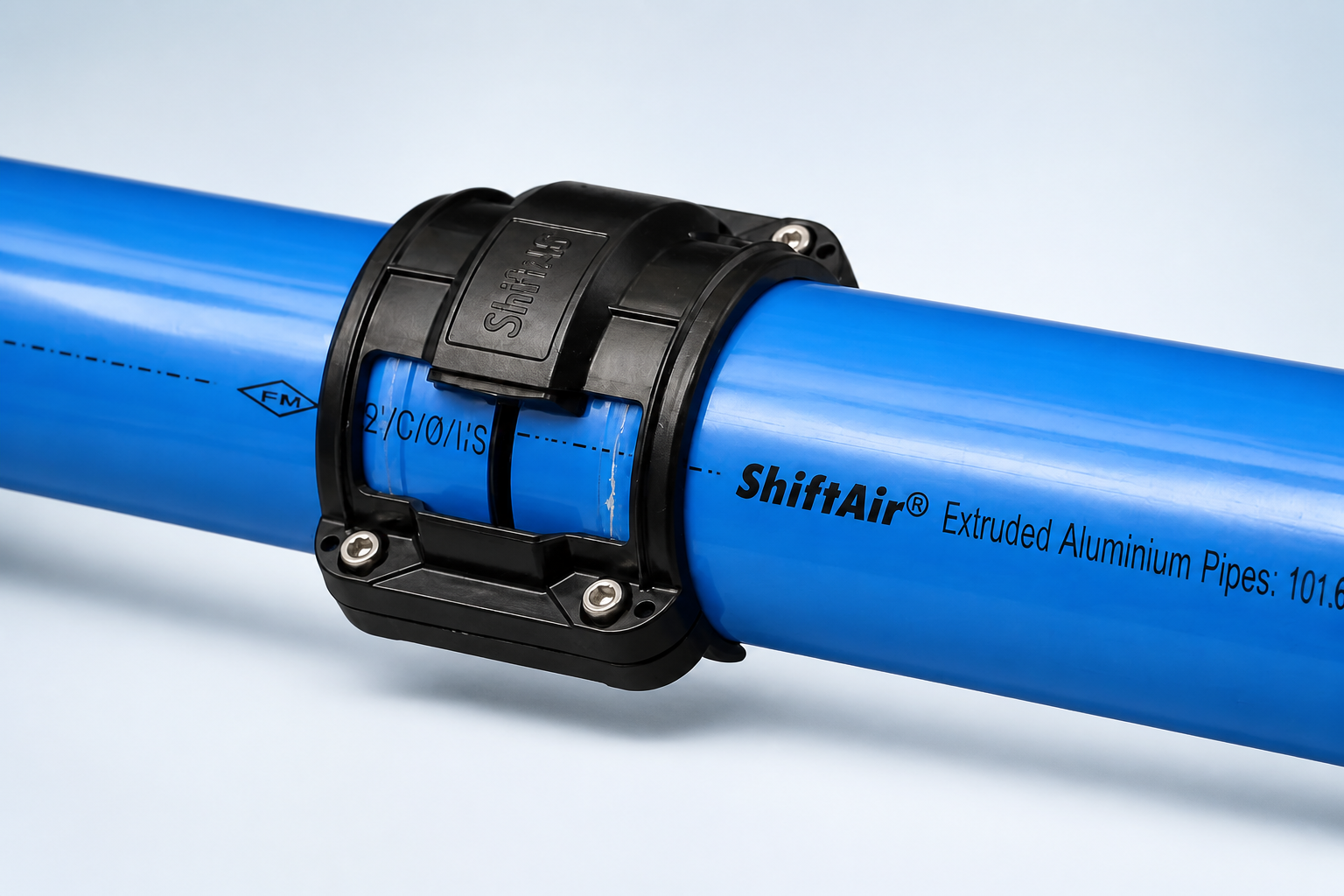
The mechanical connection matters here. ShiftAir’s clamp-fit and push-fit systems use high surface-contact integral seals and gripping rings to create leak-proof joints without welding, threading, or gluing. The company positions its jointing technology as a “100% leak-free system” and backs the piping and fittings with a 10-year warranty. That is a verifiable commitment, not a marketing claim.
4. IS 6206 and the Standards Your Supplier Should Know by Name
IS 6206:2023 is the Bureau of Indian Standards guide for selection, installation, and maintenance of air compressor plants up to 10 bar—covering the majority of Indian factory compressed air systems. It addresses leakage losses and remedies, layout of piping from the compressor to points of use, and safety devices.
A compressed air pipeline supplier who has never referenced IS 6206 in a design submission is not engineering to Indian conditions. For pressure piping, ASME B31.1/B31.3 conformity should also be demonstrated.
ShiftAir’s published compliance list provides a useful benchmark for what a serious Indian manufacturer should disclose. The company states that its products comply with ISO 8573-1:2010 (compressed air quality), ASME B31.1/31.3, and PED-2014/68/EU for piping, and that the company itself holds ISO 9001:2015 certification. Its systems also conform to CE, TUV, UL-94V-0, ROHS, ASTM E1251-17a, and IS 1608. Use this list as a comparison template when evaluating any pneumatic air piping system supplier.
The Anatomy of a Well-Engineered Compressed Air Distribution System
A compressed air distribution system manufacturer worth partnering with will design the network from the point of use backward, not from the compressor room forward. The correct engineering sequence runs:
Compressor capacity → air treatment → main header → ring main → branch lines → point-of-use connections
Every stage introduces pressure loss. A compressed air pipework supplier who ignores this sequence will deliver a system that forces the compressor to run at 8.5 bar to deliver 7 bar at the machine.
Ring Main vs. Dead-End: What a Competent Compressed Air Ring Main Supplier Should Explain
A ring or loop configuration is the preferred layout for compressed air piping system for factories because air can reach any usage point from two directions. This improves pressure stability at distant drops and reduces the impact of a single branch draw-off. A compressed air ring main supplier should also position isolation valves so that maintenance on one leg does not shut down the entire plant.
Dead-end or branch-only layouts are cheaper on paper but create pressure fluctuations at the furthest machines. If a supplier proposes a dead-end layout without a pressure-drop calculation, that is a warning sign. ShiftAir’s system is explicitly engineered for “closed loop and branch distribution layouts”, and the company offers butterfly and ball isolation valves, flow meters, pressure regulators, and monitoring devices as part of the distribution scope.
Three design rules separate an engineered ring main from a loop of pipe:
- Map peak and simultaneous demand before selecting diameter. A ring main sized for average demand will starve the network when every machine runs at once.
- Place isolation valves so maintenance on one leg does not shut the plant. This is the difference between a planned two-hour intervention and an unplanned production stoppage.
- Plan drainage and treatment upstream. Condensate that enters the distribution network will collect at low points and promote corrosion in steel systems. Drain points and treatment placement are part of the compressed air distribution system design, not an afterthought.
Material Selection: The Decision That Locks In 15 Years of Operating Cost
The Indian market offers four main piping materials for compressed air. A credible pneumatic air piping system supplier should present the trade-offs honestly, not push a single product.
| Criteria | MS / GI Steel | PPR (Plastic) | Stainless Steel | Aluminium (Modular) |
|---|---|---|---|---|
| Internal corrosion | Severe (condensate-driven rust/scale) | None | None | None (corrosion-free alloy) |
| Air purity | Poor (rust flakes damage valves) | Moderate (micro-plastic risk) | Excellent | Excellent (ISO 8573-1 capable) |
| Leakage risk | High (threaded joints, welds) | Medium (thermal cycling) | Medium (thread/weld dependent) | Zero target (clamp/push-fit seals) |
| Typical lifespan | 5–8 years | 8–12 years | 20+ years | 25+ years |
| Pressure drop behaviour | Rises as bore narrows (up to 1.5 bar) | Moderate | Good (smooth bore) | Lowest (<0.1 bar; mirror-smooth bore) |
The pressure-drop figures warrant emphasis. Comparative data published in the Indian market places MS/GI steel at up to 1.5 bar drop due to rough rust scale, while aluminium achieves less than 0.1 bar drop with a mirror-smooth inner wall (approximately 0.8 µm Ra). That difference alone can determine whether a compressor runs at 7.5 bar or 8.5 bar.
The Technical Specifications of a Credible Indian Aluminium System
ShiftAir’s published technical parameters provide a concrete benchmark for what an Indian compressed air distribution system manufacturer should disclose. The system uses seamless extruded aluminium pipe in grade 6063-T5, manufactured in accordance with EN 755-2 and EN 573-3. Fittings are A 383 grade with stainless steel bolts and gripping rings. The maximum working pressure is 15 bar, with burst pressure tested up to 60 bar. The vacuum rating is up to 0.013 bar absolute, and the operating temperature range is –20°C to 80°C. The inner surface is chromatised to reduce frictional losses, and the external coating meets QUALICOAT standards.
Pipe sizes run from 20 mm to 250 mm OD (some distributor listings extend to 290 mm), giving coverage from small machine drops to large plant headers. The system is designed for compressed air, vacuum, nitrogen, inert gases, and other industrial fluids—one modular platform across multiple utilities.
The GI/MS Failure Chain Is Predictable and Documented
The deterioration sequence of galvanised iron and mild steel networks in compressed air service follows a well-documented pattern:
- Year 1–5: internal zinc coating degrades under aggressive compressed air condensate; MS begins rusting within the first year.
- Decade one: scale and rust deposits narrow the effective bore by 15–25%.
- Resulting flow regime: turbulence increases, friction losses rise, and pressure drop climbs.
- Compressor consequence: discharge pressure is cranked up to compensate—every extra bar costs 6–8% more electricity.
- Contamination consequence: rust flakes travel downstream, clogging filters, destroying cylinder seals, and causing solenoid valve failures.
- End of life: at year 12–15, the system leaks continuously and requires shutdown replacement.
The initial material cost of GI is lower. The installed and operating cost is not.
Aluminium: The Default Upgrade, With One Caveat
Modular aluminium systems are up to 90% lighter than steel, which reduces structural load on overhead supports and makes ceiling-mounted compressed air ring main installations faster and safer. Push-fit and clamp-fit connections eliminate hot-work permits, threading, welding, and gluing. ShiftAir states that its systems are ready to use in over 50% less time than conventional piping.
The caveat: aluminium is not universally superior. Stainless steel remains the correct specification for pharmaceutical cleanrooms, food and beverage plants, and semiconductor facilities requiring ISO 8573-1 Class 1 air quality. A pneumatic air piping system supplier who claims one material solves every application is oversimplifying.
How to Vet a Compressed Air Piping System Supplier in India: A 7-Point Technical Checklist
The Indian market has many compressed air pipeline suppliers. Most can quote a bill of materials. Far fewer can demonstrate engineering competence. Use this checklist during supplier evaluation.
1. Does the Supplier Publish Material and Pressure Ratings—or Hide Behind Brochure Language?
Demand the pipe grade, the extrusion standard, the fitting material, the working pressure, the burst pressure, and the temperature range in writing. ShiftAir publishes all of these: 6063-T5 seamless extruded aluminium per EN 755-2/EN 573-3; A 383 fittings with stainless steel bolts and gripping rings; 15 bar working pressure; 60 bar burst tested; –20°C to 80°C. A compressed air pipework supplier who cannot match this level of disclosure is not engineering to a verifiable specification.
2. Are the Certifications Current and Relevant?
Look for ISO 9001:2015 for quality management, ISO 8573-1:2010 for air quality compatibility, and IS 6206 alignment for Indian installations. For pressure piping, ASME B31.1/B31.3 conformity should be demonstrable. ShiftAir also lists PED-2014/68/EU, CE, TUV, UL-94V-0, ROHS, ASTM E1251-17a, and IS 1608. A compressed air distribution system manufacturer should present certification as a technical submission, not a logo strip on a website.
3. Is the Jointing System Leak-Tested and Warranty-Backed?
ShiftAir’s clamp-fit technology uses high surface-contact integral seals and gripping rings to create leak-proof mechanical joints without welding or threading. The company backs the system with a 10-year warranty on all aluminium piping and fittings. A compressed air piping system supplier should state the leakage target their system is designed to achieve and provide a warranty that matches that claim.
4. Can the Supplier Name Indian Plants Where the System Has Run for Five Years?
Documented installations in your sector—automotive, food, pharma, textiles, electronics—are a proxy for engineering maturity. Established industrial compressed air pipe suppliers in India have supplied systems to facilities operated by ITC, Reliance, BHEL, Indian Railways, Toyota, Coca-Cola, Samsung, GAIL, and Aditya Birla Group. ShiftAir’s own industry list covers automotive and component manufacturing, pharmaceuticals, textiles, food and beverage, general engineering, packaging, electronics and PCB assembly, CNC and machining centers, chemical and petrochemical plants, cement, and solar. A supplier who cannot name a single reference older than five years is a material risk.
5. Does the Scope Include Installation, Testing, and Commissioning—or Just Material Supply?
A compressed air piping system for factories is a turnkey engineering package, not a box of pipes. ShiftAir’s published scope includes site survey, system design, material supply, turnkey installation, and commissioning. The best compressed air distribution system manufacturers provide a single accountable scope. Splitting supply from installation creates finger-pointing when leaks appear at handover.
6. Does the Design Reflect Indian Installation Realities?
Indian factories operate in tropical humidity, heavy dust, and high-vibration environments. The supplier must specify support spacing, drainage, and condensate management appropriate to Indian conditions—not a generic European datasheet. ShiftAir’s chromatised inner surface addresses frictional loss in humid conditions, and its QUALICOAT external coating addresses corrosion resistance. The system must also allow staged replacement: many plants cannot afford a full shutdown, so the supplier should plan isolation and transitions so GI and aluminium can coexist during migration.
7. Is There Post-Installation Support?
The best compressed air ring main supplier treats the network as a living asset. ShiftAir’s modular design allows future expansion “by utilising the same sets of materials,” and the system accommodates flow meters and monitoring devices for ongoing performance visibility. Post-installation leak detection and energy optimisation turn a one-time capex into a managed operating cost.
The Hidden Cost of Choosing the Cheapest Quote
A lower material price per metre is meaningless if the installed system leaks, corrodes, or cannot be expanded. The real cost of a compressed air piping system includes energy waste from pressure drop and leaks over 10–15 years, downtime for modifications, filter and tool wear from rust contamination, and labour for threading and welding on steel systems.
Indicative Indian market pricing for aluminium compressed air piping has been quoted around ₹300 per metre for a 2-inch system, with installation quoted separately at ₹150 per metre or ₹2,500 per installation point. These figures are indicative only. The point is not to anchor on a number. The point is to insist that every quotation uses the same technical scope: same diameters, same pressure-drop allowance, same number of outlets, same installation and testing scope, and same warranty terms. A compressed air distribution system manufacturer who will not normalise the scope is not giving you a comparable quote.
Aluminium pipe usually costs more per metre than GI at the point of purchase. But once installation labour, energy savings, maintenance, and downtime are included, modular aluminium systems generally come out ahead on total cost of ownership over a 10–15 year horizon. A compressed air pipeline supplier who cannot model TCO is selling a commodity, not an engineered system.
Frequently Asked Questions
Q: What working pressure and temperature range should I expect from a modular aluminium compressed air piping system?
ShiftAir’s published specifications give a useful benchmark: maximum working pressure of 15 bar, with burst pressure tested up to 60 bar, and an operating temperature range of –20°C to 80°C. Vacuum service is rated to 0.013 bar absolute. For standard factory air at 7–10 bar, this rating provides a comfortable safety margin.
Q: Can I replace old GI piping in stages without stopping production?
Yes. Staged replacement is standard practice. A competent compressed air pipework supplier will prioritise the highest-loss sections first, plan isolation valves, and manage transitions so critical production remains fed during migration. The modular nature of clamp-fit aluminium systems means new sections can be added to the same platform without welding or threading. ITT India, a ShiftAir distributor, explicitly plans GI-to-aluminium upgrades so that “GI and aluminium can coexist briefly during migration”.
Q: What is the typical lead time for a compressed air ring main installation?
Modular aluminium systems install significantly faster than welded steel because no hot work or threading is required. ShiftAir states its systems are ready to use in over 50% less time than conventional piping. A compressed air ring main supplier should provide a project-specific schedule after the site survey, but the installation-speed advantage of modular aluminium is a documented differentiator.
Q: Does the piping material affect air quality for food and pharma applications?
Directly. GI and MS piping shed rust and scale that contaminate downstream filters and products. Stainless steel and ISO 8573-1-certified aluminium systems maintain clean air delivery. ShiftAir’s aluminium system is corrosion-free by material and chromatised internally to reduce frictional losses and particle shedding. For Class 1 air quality in pharma or semiconductor applications, specify stainless steel or certified aluminium with appropriate filtration and drying.
Q: How do I compare quotes from different compressed air distribution system manufacturers fairly?
Normalise the scope on technical parameters, not just price. Ask every supplier to disclose pipe grade, wall thickness, fitting material, working pressure, burst pressure, temperature rating, pressure-drop calculation methodology, jointing technology, warranty terms, and installation scope. ShiftAir publishes 6063-T5 grade, EN 755-2 extrusion standard, 15 bar working pressure, 60 bar burst, 10-year warranty, and a full certification list—use that as the disclosure benchmark. A compressed air distribution system manufacturer who refuses to disclose these parameters is not giving you a comparable quote.
The Bottom Line for Indian Plant Teams
The right compressed air piping system supplier in India is not the one with the lowest per-metre price. It is the one who publishes verifiable material specifications, calculates pressure drop against the 0.3 bar ceiling, keeps main-line velocity below 6 m/s, specifies the correct material for your air-quality requirement, installs a leak-tested ring main to IS 6206 alignment, and stands behind the system with a 10-year warranty and post-installation audit support.
India’s compressed air piping market is shifting decisively toward modular aluminium because the energy math is documented: 6–8% energy penalty per extra bar of pressure drop, 20–35% leakage in ageing steel networks, and 15–25% savings from replacement. ShiftAir’s published specifications—6063-T5 seamless extrusion, 15 bar working pressure, 60 bar burst, 10-year warranty, ISO 8573-1 and ASME B31.1/31.3 compliance—provide a concrete technical benchmark for evaluating any compressed air distribution system manufacturer in India.
Use the checklist. Demand the specifications. Verify the certifications. And insist on a turnkey scope that includes testing and commissioning. That is how a piping expense becomes a long-term energy asset.
Ready to size a system for your plant? Share your compressor capacity, operating pressure, and machine layout, and our engineering team will return a pipe sizing calculation and an itemised Bill of Materials against your actual duty conditions—not a catalogue guess.
Request a quotation & BOM →