
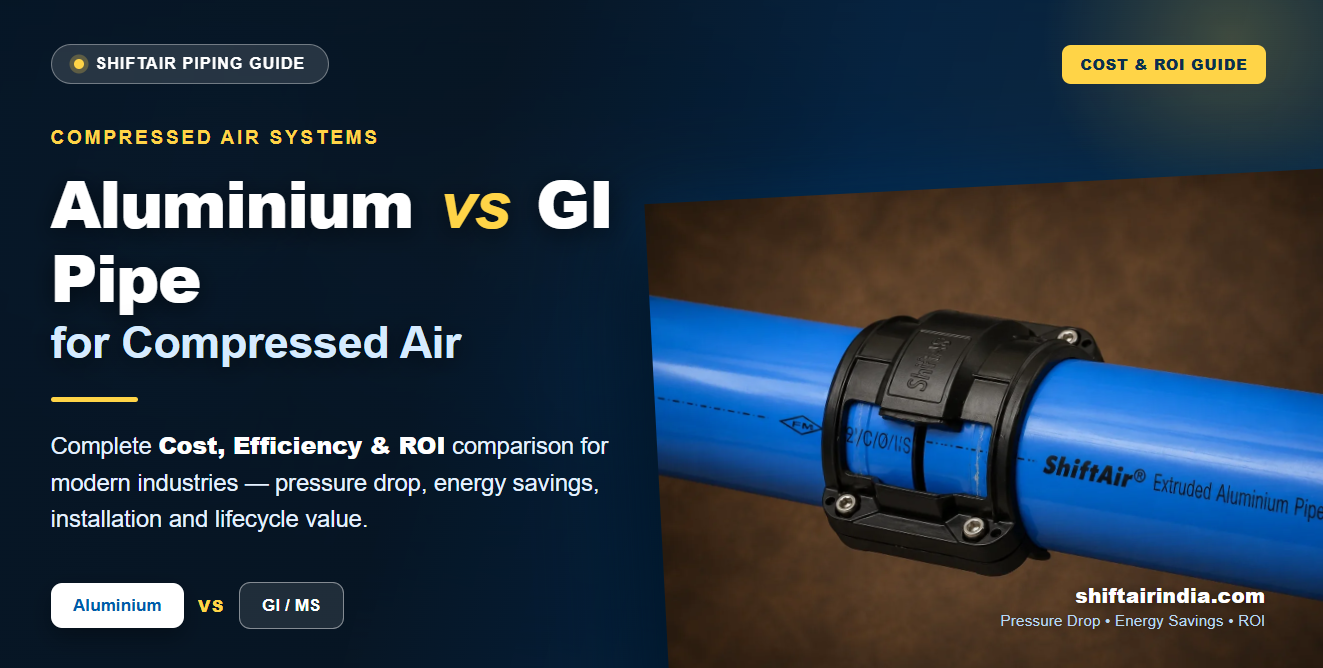
Compressed air is one of the most essential utilities in modern industries, powering pneumatic tools, automation systems, assembly lines, CNC machines, packaging equipment, and production processes. While companies invest heavily in high-efficiency compressors, many overlook one of the most important components of the system — the compressed air piping network.
The choice of piping material directly impacts: Airflow efficiency, Pressure drop, Compressor energy consumption, Maintenance cost, Air quality, Long-term operational savings. For decades, industries have used GI (Galvanised Iron) and MS (Mild Steel) pipes for compressed air distribution. However, with increasing energy costs and the demand for cleaner, more efficient systems, aluminium compressed air piping systems are becoming the preferred choice across manufacturing facilities.
Compressed Air Piping: The Hidden Factor Behind Energy Efficiency
Most industries focus on compressor efficiency but underestimate the impact of the piping system. A compressed air network loses efficiency due to:
- Internal pipe friction
- Pressure drops
- Leakage
- Corrosion buildup
- Poor pipeline design
Even a highly efficient compressor cannot perform optimally if the distribution system creates excessive resistance. A poorly designed or ageing piping network forces the compressor to work harder to maintain required pressure, increasing electricity consumption and operating costs.
In many plants, the compressor is blamed for high energy bills when the real culprit is the piping. A compressor that discharges at 7.5 bar to compensate for a 1.5 bar piping loss is effectively wasting energy every hour of operation. Over a year, that hidden loss can equal the cost of a new piping network — which is why piping deserves the same engineering attention as the compressor itself.
Which Pipe Is Best for Compressed Air Systems?
The best pipe for compressed air depends on:
- Required pressure
- Air quality requirements
- Operating environment
- Installation needs
- Lifecycle cost
For modern industrial applications, aluminium compressed air piping is widely preferred because it provides:
- Smooth internal airflow
- Low pressure drop
- Corrosion-free performance
- Faster installation
- Easy expansion
- Lower maintenance cost
Traditional GI and MS pipes may have lower initial material costs, but their long-term operating expenses can be significantly higher.
Aluminium vs GI Pipe for Compressed Air: Complete Comparison
| Feature | Aluminium Compressed Air Pipe | GI/MS Pipe |
|---|---|---|
| Material | 6063-T5 Aluminium Alloy | Galvanised Iron / Mild Steel |
| Internal Surface | Smooth seamless extruded bore | Rough internal surface |
| Airflow Resistance | Very low | Higher friction losses |
| Corrosion Resistance | Completely rust resistant | Corrosion possible |
| Air Quality | Cleaner compressed air | Risk of rust particles |
| Installation | Modular push-fit system | Welding/threading required |
| Hot Work | Not required | Required |
| Installation Speed | Up to 50% faster | Slower |
| Maintenance | Minimal | Regular maintenance |
| Future Expansion | Easy modification | Difficult |
| Lifecycle Cost | Lower | Higher |
Why Pressure Drop Matters in Compressed Air Systems
Pressure drop is one of the biggest hidden expenses in compressed air networks. When compressed air flows through a pipe, friction between the air and internal pipe surface reduces pressure. The compressor must compensate for this loss by increasing output pressure.
This results in:
- Higher electricity consumption
- Increased compressor loading
- Reduced system efficiency
The Energy Loss Rule in Compressed Air Systems
A commonly used industry guideline states:
Example: A conventional piping system may require compressor operating pressure of 6.9 bar. After improving piping efficiency and reducing pressure losses, required pressure might be 5.5 bar. The reduction in operating pressure can result in approximately 10% improvement in compressor energy efficiency. For industries operating compressors continuously, these savings can create significant annual cost reductions.
Another way to understand this: a 1 bar reduction in discharge pressure typically reduces compressor power consumption by about 6–7% for a fixed-speed compressor, and even more for variable-speed machines operating at partial load. Because compressed air is one of the most expensive utilities in a plant — often costing far more per unit of energy than electricity itself — every 0.1 bar saved at the compressor translates into real money.
Aluminium Compressed Air Piping: Why 6063-T5 Alloy Makes a Difference
Modern aluminium compressed air systems use 6063-T5 Extruded Aluminium Alloy. This specialised aluminium grade provides excellent mechanical strength, corrosion resistance, and dimensional stability.
1. Smooth Seamless Inner Bore Reduces Pressure Loss
Unlike GI/MS pipes, aluminium pipes are manufactured through extrusion technology, creating a smooth internal surface. Benefits include:
- Reduced friction
- Improved airflow velocity
- Lower turbulence
- Reduced compressor workload
The smoother the pipe surface, the easier compressed air travels through the network. A rough GI pipe can have a surface roughness several times higher than extruded aluminium, which directly increases the friction factor and pressure loss for the same flow rate.
2. Zero Rust Risk and Cleaner Air Quality
Compressed air naturally contains moisture. Over time, moisture reacts with steel pipes and creates internal corrosion. Rust inside piping can lead to:
- Air contamination
- Blockages
- Reduced internal diameter
- Increased pressure drop
Aluminium piping eliminates internal rust formation, helping industries maintain cleaner compressed air quality. This supports compressed air quality requirements under ISO 8573-1:2010 Standards.
3. Lightweight and Faster to Handle
Aluminium weighs roughly one-third of steel for the same nominal pipe size. This reduces structural support requirements, allows faster handling at height, and lowers installation fatigue for technicians. Lighter pipe also means fewer ceiling anchors and simpler modifications during plant expansion.
4. Stable Performance Over Time
Because aluminium does not corrode internally, the internal diameter remains constant for decades. A GI pipe that corrodes gradually loses bore diameter, increasing pressure drop and compressor load year after year — a hidden cost that never appears on the purchase invoice.
Can GI Pipe Be Used for Compressed Air Systems?
Yes, GI pipes can be used for compressed air applications. They are commonly found in:
- Small workshops
- Older industrial plants
- Low-pressure systems
However, GI pipes have certain limitations.
Limitations of GI Pipes for Compressed Air
1. Internal Corrosion — Although galvanisation provides protection, the coating can deteriorate over time due to moisture, condensation, and air contaminants. Internal corrosion reduces pipe efficiency.
2. Higher Pressure Drop — GI pipes generally have rougher internal surfaces, more joints, and higher friction losses. This increases compressor energy requirements.
3. Slow Installation Process — GI installation requires cutting, threading, alignment, sealing, and skilled labour. Compared with aluminium modular piping, installation time is considerably higher.
4. Galvanised Coating Can Flake — Over years of service, the zinc coating can flake or dissolve, especially at threaded joints where the coating is already compromised. These flakes can travel downstream and block valves, tools and nozzles.
5. Difficult to Modify — Adding a new machine drop to an existing GI network often requires cutting, re-threading and re-sealing the line, which means shutting down the section and losing production time.
MS Pipe for Compressed Air: Traditional but Expensive Over Time
MS pipes have been widely used because they are strong and easily available. However, for compressed air systems, MS pipes create several challenges.
Problems with MS Compressed Air Piping
Internal Rust Formation — Moisture inside compressed air pipelines causes oxidation. This can result in:
- Rust particles entering air supply
- Reduced pipe diameter
- Increased maintenance
- Lower efficiency
Welding Requirements — MS piping installation requires:
- Welding equipment
- Skilled manpower
- Hot work permits
- Safety precautions
This increases installation time and project complexity.
Weld Quality Varies — Internal weld beads, slag inclusions and incomplete penetration can create turbulence and leak paths that are difficult to detect. A single poor weld can become a permanent leak that costs thousands of rupees per year in wasted compressed air.
Modification Is Costly — Once welded, an MS network is essentially permanent. Relocating a machine or adding a new line often means cutting out entire sections and re-welding, with hot work permits and safety supervision.
Compressed Air Piping Installation Cost: Aluminium vs GI/MS
Many companies compare only the initial material price. However, the real cost includes:
Installation Comparison
Aluminium Compressed Air Piping Advantages:
- No welding
- No threading
- No hot work
- Lightweight handling
- Faster installation
- Easy modification
Installation can be up to 50% faster compared with traditional piping.
GI/MS Installation Requires:
- Pipe cutting
- Welding/threading
- Surface preparation
- Alignment
- Leak testing
This increases labour cost and downtime.
Hidden Installation Costs in GI/MS Projects
- Hot work permits and fire watch — welding in occupied plants requires permits, fire watchers and sometimes production shutdowns.
- Skilled welder availability — certified welders are scarce and expensive, and quality varies between shifts.
- Post-weld cleaning and painting — welds must be cleaned, primed and painted to slow corrosion, adding labour and time.
- Leak testing and rework — threaded and welded joints frequently need rework after the first pressure test.
- Production downtime — every hour of shutdown for piping work has an opportunity cost far greater than the piping itself.
ROI Analysis: Why Aluminium Compressed Air Piping Pays Back Faster
The biggest advantage of aluminium piping is not only installation savings but also operational efficiency.
Example ROI Calculation
Assume:
Compressor power consumption: 100,000 kWh/year
Electricity cost: ₹8/kWh
Annual energy cost: ₹8,00,000
If improved piping reduces energy consumption by 10%:
Annual saving: 10,000 kWh
Financial saving: ₹80,000/year
Additional savings come from:
- Reduced maintenance
- Lower leakage losses
- Less downtime
- Longer service life
Over the system lifecycle, aluminium piping can provide a significantly better return compared with conventional GI/MS piping.
Extended ROI Example: 75 kW Compressor
Consider a 75 kW compressor running 6,000 hours per year at ₹8/kWh. Annual energy cost is roughly ₹36,00,000. If aluminium piping reduces system pressure drop by 0.5 bar and improves efficiency by 4%, the annual saving is about ₹1,44,000. Over a 10-year life, that is ₹14,40,000 in energy savings alone — before counting maintenance, leakage and downtime benefits.
Total Cost of Ownership: The Real Comparison
Material price is only a small fraction of the true cost of a compressed air piping network. A proper total cost of ownership (TCO) model should include:
| Cost element | Aluminium piping | GI/MS piping |
|---|---|---|
| Material cost | Higher upfront | Lower upfront |
| Installation labour | Lower (modular, no welding) | Higher (welding/threading) |
| Hot work permits & safety | Not required | Required |
| Energy cost over life | Lower (low pressure drop) | Higher (rough, corroded bore) |
| Maintenance & leak repair | Minimal | Frequent |
| Production downtime for modifications | Low (modular) | High (cut & weld) |
| Air quality treatment cost | Lower (no rust) | Higher (filters, dryers) |
| Service life | 20–25+ years | 8–12 years |
| Resale / reuse value | Components reusable | Scrap value only |
When all these factors are added, aluminium piping usually wins on TCO despite a higher initial price. The payback period is typically 12 to 30 months, depending on compressor size, operating hours and electricity tariff.
Air Quality and ISO 8573-1:2010
Compressed air quality is often critical for food, pharmaceutical, electronics and precision manufacturing. The ISO 8573-1:2010 standard defines purity classes for particles, water and oil in compressed air.
Rust and scale from GI/MS piping can push particle counts above the required class, forcing plants to install additional filtration that adds pressure drop and maintenance. Aluminium piping, being rust-free, helps maintain the specified air quality class at a lower treatment cost.
For plants certified to ISO 8573-1 or serving food and pharma processes, the choice of piping material is not just an energy decision — it is a compliance and product-safety decision.
Layout and Compressor Room Design
Even the best piping material cannot fix a poor layout. Key design principles for a low-loss compressed air network include:
- Ring main instead of branch line — a looped ring main balances pressure across the plant and reduces the effect of individual draw-offs.
- Generous pipe sizing — design for low velocity (typically below 6–8 m/s in mains) to minimise friction loss.
- Minimise fittings and bends — every elbow, tee and valve adds pressure drop.
- Sloped lines with drain points — condensate must be removed before it reaches tools.
- Point-of-use filtration and regulators — treat air close to the machine, not only at the compressor room.
- Future expansion provisions — modular aluminium piping makes future drops easier; plan them from day one.
Aluminium modular systems make it easier to follow these principles because new drops and modifications can be added without welding or shutdowns.
Leakage: The Silent Cost of Compressed Air
Leakage is one of the largest sources of wasted energy in compressed air systems. In poorly maintained plants, leaks can account for 20–30% of total compressor output.
Common leak points include:
- Threaded and welded joints in GI/MS networks
- Corroded pipe sections
- Worn seals in fittings and valves
- Improperly assembled modular connections
Aluminium modular piping, when correctly installed, reduces the number of potential leak paths compared with a threaded GI network. The push-fit or clamp joints are factory-engineered and tested, and can be re-checked or re-tightened without cutting the pipe.
Which System Suits Different Indian Factory Projects?
Small CNC Workshop
Limited pipe sizes, quick installation and future machine drops matter most. Aluminium modular piping is usually the better choice.
Automotive Production Hall
Large ring mains, multiple sizes, vibration sources and frequent layout changes favour aluminium piping with engineered support design.
Large Compressor-Room Header
High flow and large diameters require product-specific engineering. Aluminium headers are increasingly used for their low pressure drop.
Packaging Line Extension
Fast branch and drop installation during production favours push-fit aluminium piping, which can be added without hot work.
Food or Pharmaceutical Plant
Air quality, cleanliness and ISO 8573-1 compliance make aluminium piping the natural choice over corroding steel.
Factory Replacing Old GI Network
Compare complete product families, execution plans and shutdown strategy. Aluminium usually wins on lifecycle cost.
Selection Checklist Before You Buy
Before approving any compressed air piping system, request written confirmation of:
- Pipe material and alloy
- Available diameters
- Maximum allowable working pressure by size and temperature
- Operating temperature range
- Compatible gases or fluids
- Seal material
- Retention mechanism
- Required installation tools
- Support-spacing requirements
- Vibration and thermal-movement guidance
- Testing or certification information
- Warranty conditions
- Reuse and modification procedure
- Availability of fittings and spares in India
- Installer training and after-sales support
What Type of Pipe Is Most Commonly Used for Compressed Air?
Historically, industries commonly used:
- GI pipes
- MS pipes
Today, modern manufacturing facilities increasingly use:
- Aluminium compressed air piping systems
- Stainless steel piping
- Engineered modular piping solutions
because industries require:
- Higher energy efficiency
- Cleaner air
- Flexible expansion
- Reduced maintenance
Aluminium vs Steel Air Compressor Tanks: Understanding the Difference
Air compressor tanks and piping systems serve different purposes. A compressor tank stores compressed air, while piping distributes air throughout the facility.
| Feature | Aluminium Tank | Steel Tank |
|---|---|---|
| Weight | Lightweight | Heavy |
| Corrosion Resistance | Excellent | Requires protection |
| Industrial Strength | Application dependent | Very high |
| Common Usage | Portable systems | Industrial compressors |
For industrial compressed air efficiency, the piping network generally has a greater impact on daily operating costs.
What Are the Specifications of Aluminium Compressed Air Piping?
Typical specifications include:
Material: 6063-T5 Aluminium Alloy
Construction:
- Extruded seamless pipe
- Smooth internal bore
- Modular connection system
Suitable Applications:
- Automotive plants
- Pharmaceutical industries
- Food processing
- Textile manufacturing
- Engineering industries
- CNC machining facilities
Final Verdict: Aluminium or GI/MS Pipe — Which Is Better for Compressed Air?
GI and MS pipes have been used for decades and can still serve basic compressed air applications. However, industries looking for:
- Lower energy consumption
- Reduced pressure drop
- Cleaner compressed air
- Faster installation
- Lower lifecycle costs
are increasingly choosing aluminium compressed air piping systems.
With its 6063-T5 seamless construction, corrosion-free performance, and efficient airflow characteristics, aluminium piping provides a future-ready solution for modern compressed air networks.
The practical verdict: if the plant operates more than one shift, has more than a few machines, or plans to expand, aluminium piping will almost always deliver a better total cost of ownership than GI/MS — even though the material invoice looks higher on day one.
Frequently Asked Questions (FAQs)
Upgrade to Aluminium Compressed Air Piping
ShiftAir Transmission provides modular aluminium pipes, fittings, valves, installation tools, layout guidance and project support for industrial compressed air networks across India.
Share your factory layout, pipe sizes, compressor capacity, working pressure, machine list and project timeline for a plant-specific recommendation.
Phone: +91-129-4177575
Mobile/WhatsApp: +91-9311346250
Email: sales@shiftairindia.com