
A factory compressed air network can often be expanded with little or no interruption to normal production—but only when the new pipeline is designed, assembled and tested separately before the final connection. The safest strategy is usually to minimise the live-system interface, not to perform the entire project on a pressurised network.
Can a Compressed Air Network Really Be Expanded Without Shutdown?
Sometimes. The realistic answer depends on what “without shutdown” means for the plant.
| Continuity target | What it means | Typical approach |
|---|---|---|
| Zero plant shutdown | Critical production continues throughout the project | Sectional isolation, redundant supply, temporary compressor or an approved live-connection system |
| Zero shutdown during installation | New piping is installed while production operates; only final tie-in is isolated | Offline prefabrication followed by a short controlled connection window |
| Partial shutdown | Only one department or zone stops | Isolation valves and staged commissioning |
| Micro-shutdown | A short planned interruption occurs during a break, shift change or maintenance period | Preassembled network with a prepared tie-in point |
| Full shutdown | Complete network is isolated and depressurised | Required where safe isolation cannot otherwise be achieved |
For many factories, a micro-shutdown or zone shutdown is safer, easier and more economical than attempting an entirely live connection. The project team should define the acceptable production interruption before designing the solution.
Six Ways to Protect Production During Network Expansion
Why modular aluminium piping helps
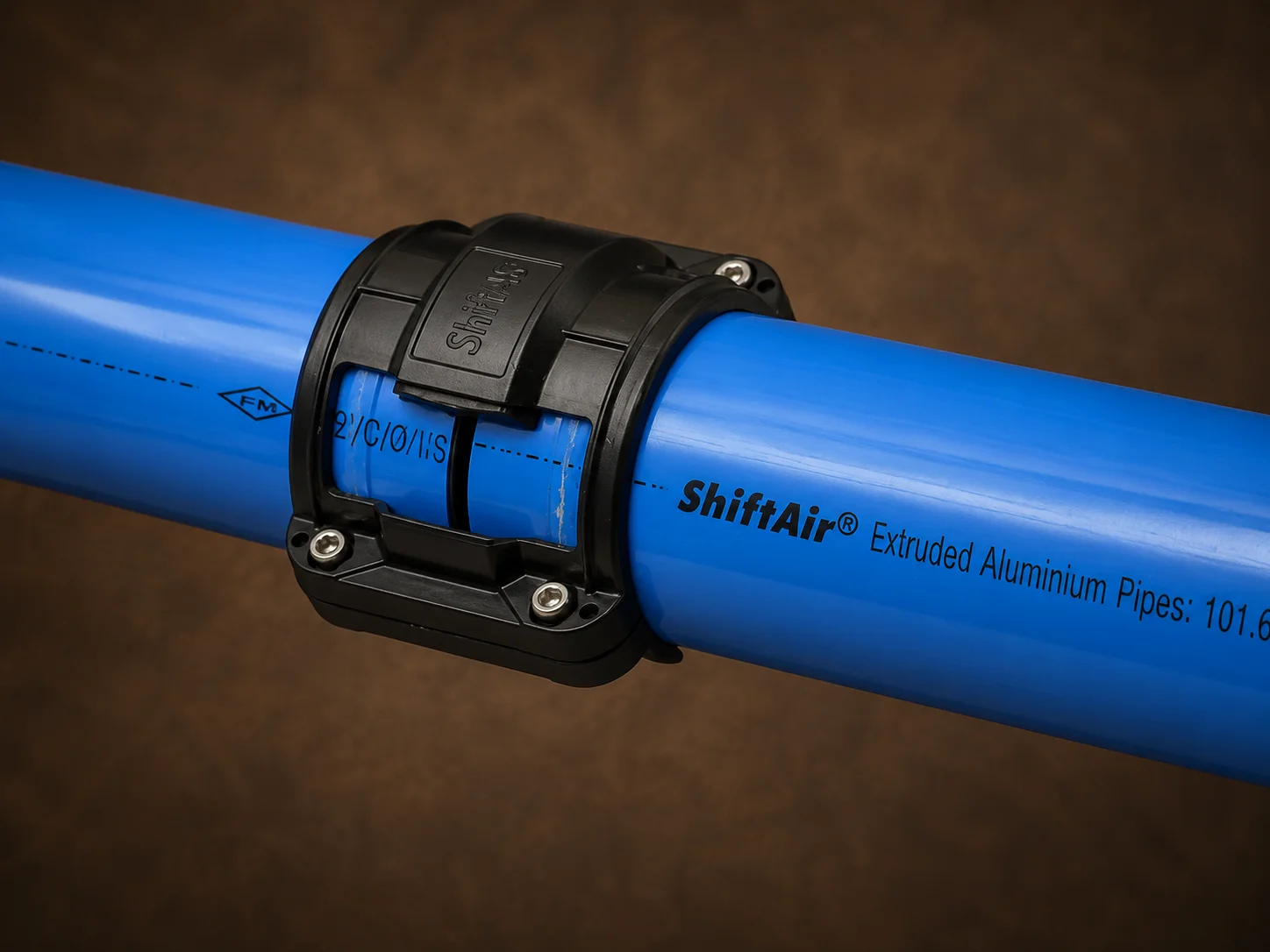
A modular aluminium system can allow most of the new network to be installed without welding or threading. Pipes, fittings, branches, valves and supports can be assembled as a separate network, leaving only the final connection to the existing supply.
Review push-fit vs clamp-type aluminium piping when selecting the joint system for an expansion project.
Start With a Pre-Expansion Network Survey
Before adding a machine or production line, document the existing compressed air system. A pipeline extension can fail even when the new pipe is correctly installed if the existing compressor, dryer, header or branch lacks spare capacity.
The survey should record:
- Compressor models, capacities and control arrangement
- Operating and unloaded pressure
- Receiver capacity
- Dryer and filter capacity
- Existing pipe material, diameter and condition
- Ring main, branch and isolation-valve locations
- Pressure at critical machines during normal and peak demand
- Known leakage and maintenance issues
- Air quality or dew-point requirements
- Production schedule and permitted work windows
- Confirmed and expected future machines
If drawings are outdated, prepare an as-built network map before designing the extension.
Check Capacity Before Extending the Pipeline
Adding pipe does not create compressed air capacity. The complete system must support the additional flow at the required pressure and air quality.
Calculate the new demand
For every new machine, identify average flow, peak flow, operating pressure, duty cycle, connection size and air-quality requirement. Evaluate how many consumers can operate simultaneously.
Recalculate the existing network
Check the header and upstream sections through which the new demand will flow. A new branch connected to an undersized main can increase pressure loss for both old and new production lines.
Review treatment equipment
Dryers and filters must handle the additional flow without unacceptable pressure loss or deterioration in air quality. Sensitive applications may need separate point-of-use treatment.
Measure, do not guess
Where production is complex, flow logging and pressure measurement can reveal peak periods, unloaded compressor operation and capacity constraints. Use ShiftAir’s pressure-drop calculator for preliminary pipeline assessment.
A Safe Phased Expansion Plan
Define the continuity requirement
Identify machines that cannot stop, machines that can stop briefly and the minimum pressure required to maintain acceptable production.
Design the final network
Select the route, pipe sizes, isolation zones, supports, valves, drains, drops and future connection points. Compare ring main and branch-line layouts.
Approve the method statement
Document scope, responsibilities, hazards, isolation boundaries, work permits, emergency response and commissioning sequence.
Install the extension offline
Mount and assemble the new headers, branches and machine drops without connecting them to the pressurised network.
Inspect before tie-in
Verify supports, alignment, fittings, valves, accessibility, labels and completeness while corrections can still be made without affecting production.
Provide continuity controls
Prepare isolation, bypass or temporary supply according to the approved production plan.
Complete the controlled connection
Use the approved tie-in method under the factory’s energy-control and work-permit procedure.
Pressurise progressively
Follow the manufacturer’s commissioning instructions. Check the new network in stages rather than introducing full pressure without inspection.
Verify production performance
Measure pressure at critical old and new users during realistic demand. Confirm that air quality and machine performance remain acceptable.
Update documentation
Record the final pipe sizes, valve locations, drops, test results and reserved expansion points.
When Should a Temporary Compressor Be Used?
A temporary compressor can supply selected production areas while the main network or one section is isolated. However, capacity alone is not enough.
Confirm:
- Required flow and pressure during peak operation
- Air quality, filtration and dew point
- Fuel, electrical supply or ventilation requirements
- Receiver capacity and pressure stability
- Safe location and noise management
- Connection hose and pipe pressure rating
- Non-return valves and isolation arrangement
- Condensate disposal
- Emergency shutdown and monitoring
A temporary unit that delivers insufficiently treated air can protect production volume while damaging product quality or sensitive machinery. Its output must match the application—not only the pressure gauge.
Can a Pressurised Compressed Air Main Be Tapped Live?
Some proprietary piping systems offer manufacturer-designed equipment for adding a connection to an operating compressed air line. This is commonly discussed as live tapping or hot tapping, although terminology and procedure vary.
It should only be considered when:
- The exact pipe and fitting system supports the procedure
- The manufacturer supplies or approves the tapping equipment
- Pipe condition, material, pressure and temperature are within limits
- The new branch size and location are authorised
- Trained and competent personnel perform the work
- A written risk assessment and method statement are approved
- The factory’s permit-to-work and hazardous-energy procedures are followed
- An emergency isolation plan is available
The preferred design is often to install spare valved connections during the original project, eliminating the need to modify a pressurised main later.
Protect Air Quality During Expansion
Network expansion can introduce dust, swarf, moisture, oil, seal contamination or construction debris. This is especially important in food, pharmaceutical, electronics, paint and precision manufacturing facilities.
The method statement should address:
- Clean storage of pipes and fittings
- Protection of open pipe ends
- Controlled cutting and deburring
- Removal of installation debris
- Correct seal handling
- Drainage and condensate management
- Required flushing or cleaning procedure
- Filter inspection or replacement
- Air-quality verification before process use
Modular aluminium piping can help avoid internal rust associated with ageing ferrous lines. See the aluminium versus old GI compressed air network comparison.
Testing and Commissioning Without Disrupting Production
Testing must be planned before the network is connected. The applicable method depends on the piping system, site rules and manufacturer instructions.
A commissioning plan may include:
- Completion and visual inspection of the offline network
- Verification of supports, fittings and closed valves
- Approved pre-test of isolated sections where feasible
- Controlled tie-in under the energy-control procedure
- Gradual pressurisation with personnel clear of potential joint trajectories
- Leak inspection using an approved method
- Valve-operation checks
- Pressure measurement at the new and existing critical users
- Air-quality confirmation where required
- Formal handover and drawing update
Never use hands or exposed skin to search for compressed air leaks.
Expansion Strategies for Different Indian Factories
| Factory situation | Likely continuity strategy | Key consideration |
|---|---|---|
| Automotive assembly line | Offline ring extension with zoned tie-in | Maintain pressure for existing tools and robots |
| Pharmaceutical production | Isolated construction and validated commissioning | Air quality, documentation and contamination control |
| Food packaging plant | Phased installation plus temporary treated supply if required | Product-contact risk and dew point |
| CNC workshop adding two machines | Preassembled branch and short planned tie-in | Verify capacity of the existing header |
| Textile hall expansion | Extend the ring or create a new zoned loop | High simultaneous demand and future machines |
| Electronics facility | Clean offline installation with controlled commissioning | Particulate, moisture and oil control |
| Multi-building campus | New independent zone connected through an engineered header | Isolation, pressure stability and service access |
Common Expansion Mistakes
- Assuming the compressor has spare capacity because its pressure appears normal
- Connecting new machines to the nearest pipe without checking its diameter
- Building the entire project around an unverified live-tapping assumption
- Failing to map isolation valves and downstream users
- Using an undersized temporary compressor or untreated temporary air
- Installing new pipe before approving the final tie-in location
- Ignoring dryer, filter and receiver capacity
- Testing the new system against operating machinery without a commissioning plan
- Adding long dead-end branches where a ring or zoned layout is needed
- Leaving new pipes open during construction
- Not updating drawings and valve labels
- Treating “no shutdown” as more important than worker safety
Review the detailed list of compressed air piping installation mistakes before approving the project.
Pre-Expansion Approval Checklist
- Existing network surveyed and documented
- New average and peak demand calculated
- Compressor, receiver, dryer and filters checked
- Pressure drop assessed for existing and new users
- Continuity target agreed with production
- Isolation boundaries physically verified
- Temporary supply requirements calculated
- Final tie-in method approved
- Risk assessment, permits and energy-control plan completed
- New network installed and inspected offline
- Commissioning and emergency procedures approved
- As-built documentation and training included
Frequently Asked Questions
Can a compressed air pipe be extended while the compressor is running?
The new extension can often be assembled separately while the existing system operates. The final connection normally requires isolation and depressurisation unless an approved proprietary live-connection method is available.
What is the safest way to avoid a full factory shutdown?
Complete most work offline, isolate only the affected zone and schedule a short controlled tie-in. A bypass or temporary compressor can protect critical production where technically suitable.
What is compressed air hot tapping?
It is a specialised method for adding a connection to a pressurised line using equipment and fittings designed for that operation. It is not a general drilling technique and must not be improvised.
Can a branch be added to any aluminium piping system under pressure?
No. Live expansion depends on the exact manufacturer, pipe, fitting, size, pressure, condition and approved procedure. If compatibility is uncertain, isolate and depressurise the section.
Will adding a larger pipe solve low pressure at new machines?
Not necessarily. Low pressure can result from insufficient compressor capacity, restrictions, leaks, treatment equipment, an undersized upstream header or peak demand. Diagnose the complete system.
Should the network be changed from a branch to a ring during expansion?
It may be beneficial where several users operate simultaneously or future growth is expected. Compare both options using layout, airflow and pressure-drop calculations.
Can a rental compressor supply production during installation?
Yes, if it provides the required flow, pressure and air quality and is connected through a safely engineered arrangement. Treatment, ventilation, condensate and monitoring must be planned.
How should future shutdowns be avoided?
Install accessible isolation valves, spare capped and valved connection points, correctly sized headers and documented expansion zones during the current project.
Plan Your Factory Air Network Expansion
ShiftAir Transmission supports compressed air network surveys, modular aluminium piping, layout planning, installation coordination, production-line extensions and replacement projects across India.
Share your plant layout, existing pipe sizes, compressor details, current pressure, new machine demand and permitted work window for a project-specific review.
Phone: +91-129-4177575
Mobile/WhatsApp: +91-9311346250
Email: sales@shiftairindia.com