
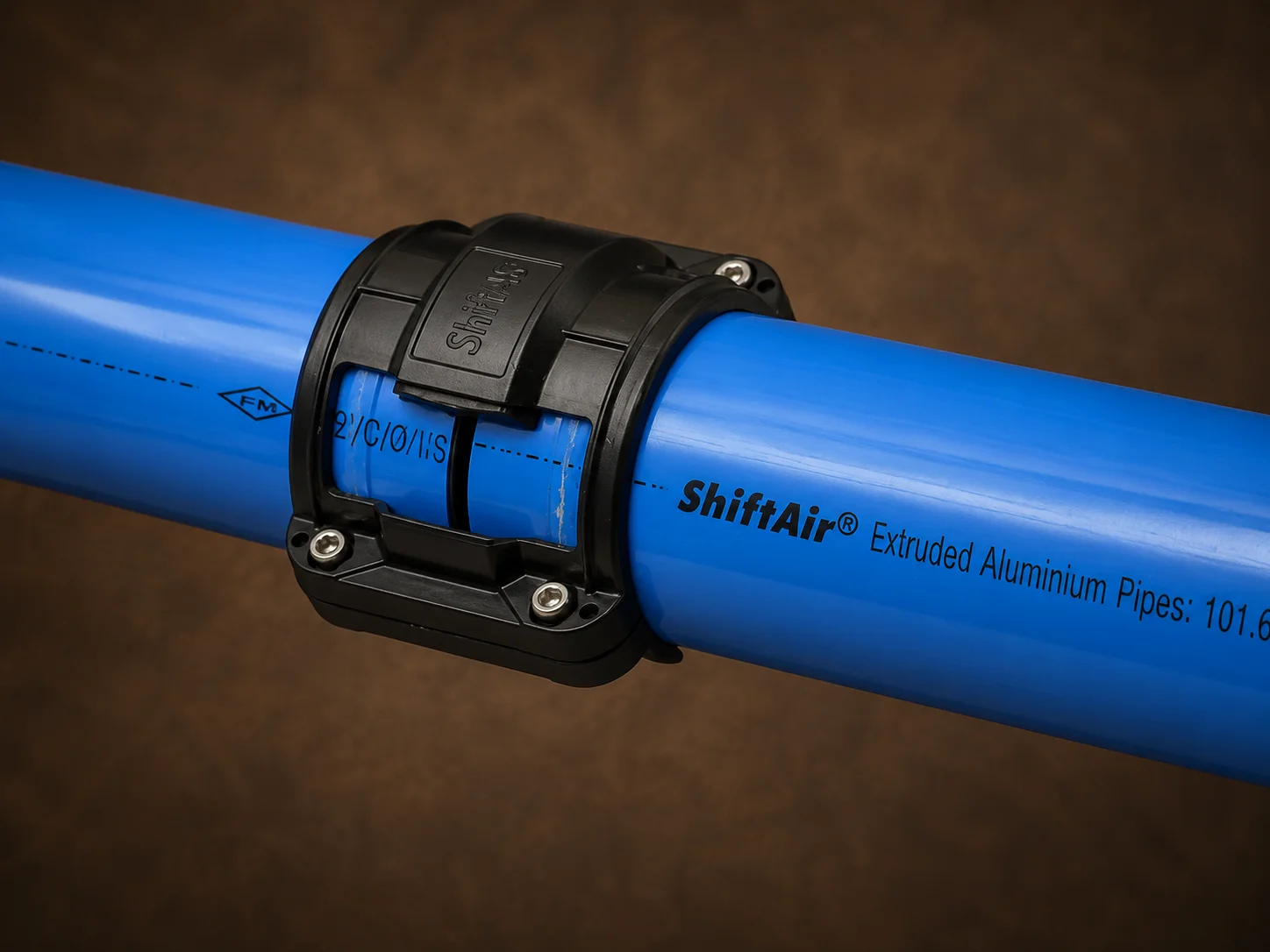
Push-fit and clamp-type aluminium piping systems both offer a modular alternative to welded or threaded compressed air pipelines. The important difference is how the pipe is retained and sealed inside each connector. That difference can affect preparation, tools, installation control, available sizes, inspection, modification and total project cost.
Push-fit may suitSmaller and medium pipe sizes, quick extensions, machine drops and projects where fast insertion-based assembly is a priority.
Clamp-type may suitPlant headers, larger diameters, installations requiring a visibly secured mechanical joint and projects standardised around clamp assembly.
The connection name alone cannot identify the better system. Compare the complete tested assembly: pipe, fitting body, retention method, seal, pressure rating, temperature range, installation procedure, warranty and local support.
First, Understand What “Push-Fit” and “Clamp-Type” Mean
These terms describe broad connection approaches; they are not universal engineering standards. Two products called push-fit may use different gripping rings, nuts, insertion depths, O-rings and locking procedures. Clamp-type systems can also differ in clamp material, bolt arrangement, pipe-end preparation and seal design. Some modular systems combine mechanisms. A pipe may be inserted into a fitting and then mechanically tightened, while larger sizes in the same product family may use split shells or external clamps. Therefore, buyers should evaluate the exact manufacturer and size—not assume that every diameter uses the same joint.Important: Never mix pipes and fittings from different modular systems unless the manufacturers explicitly approve the combination. Similar outside diameters do not confirm compatibility.
How Does Push-Fit Aluminium Piping Work?
In a typical push-fit connection, the prepared pipe end is inserted into the fitting to the specified depth. An internal seal creates the pressure boundary, while a gripping or retention component resists pipe withdrawal. Some designs require a nut to be tightened after insertion; others use a different locking arrangement.Typical push-fit installation sequence
1CutMake a clean, square cut using the approved tool.
2PrepareDeburr, clean and inspect the pipe end.
3MarkMark the manufacturer’s required insertion depth.
4ConnectInsert and complete the specified locking or tightening step.
Potential advantages
- Fast assembly when the installer follows the prescribed preparation method
- Limited dependence on welding, threading and hot work
- Convenient for smaller branches, drops and production-line modifications
- Clean installation in occupied industrial areas
- Modular components can simplify future reconfiguration where the system permits reuse
Points requiring control
- Insertion depth must be correct and verifiable
- Pipe ends must not damage or displace the internal seal
- Deburring and cleaning cannot be skipped
- Retention and tightening steps vary between manufacturers
- Availability and joint design may change at larger diameters
How Does Clamp-Type Aluminium Piping Work?
A clamp-type system uses a mechanical clamp, split body or bolted connector to secure the pipe and fitting. The seal normally sits inside the joint, while the external clamping components apply or maintain the required mechanical restraint. Depending on the product, the pipe may require marking, preparation, drilling, lugging, grooving or another manufacturer-defined step. Other clamp systems use plain prepared pipe ends. The correct procedure must come from the installation manual for the exact product and diameter.Potential advantages
- Visible mechanical joint assembly can make installation inspection straightforward
- Suitable clamp-based product families may cover plant headers and larger diameters
- Mechanical fasteners can provide a defined tightening procedure
- Modular construction can support disassembly and plant modification where approved
- All-aluminium clamp components can reduce dependence on dissimilar external body materials in systems designed that way
Points requiring control
- Specified bolt sequence and torque must be followed
- Uneven or incomplete tightening can compromise joint performance
- Required pipe-end preparation must be consistent
- Installer training and correct tools remain essential
- Fasteners and seals must match the intended environment and application
Push-Fit vs Clamp-Type: Detailed Comparison
| Selection factor | Push-fit | Clamp-type | What the buyer should verify |
|---|---|---|---|
| Basic connection | Pipe inserts into an internally retained fitting | External mechanical clamp or split connector secures the joint | Exact retention and sealing mechanism |
| Installation speed | Often very fast in smaller sizes | Fast, but may include tightening or pipe preparation steps | Measured installation procedure for the required diameter |
| Visual inspection | Insertion mark and locking position should be checked | Clamp position and fastener engagement are visible | Manufacturer’s inspection checklist |
| Tools | Cutter, deburring tools, depth marker and specified tightening tools | Cutter, deburring tools, torque tools and any product-specific preparation tool | Complete tool list and calibration needs |
| Large diameters | Availability varies; some families change joint technology | Commonly considered for larger industrial headers in suitable product ranges | Available size range and rating by diameter |
| Disassembly | Possible in approved reusable systems | Often mechanically accessible for approved disassembly | Reuse rules for pipe, fitting and seal |
| Installer sensitivity | Insertion depth, seal protection and locking are critical | Pipe preparation, alignment and tightening are critical | Training, supervision and documented checks |
| Vibration and movement | Depends on retention design, supports and flexible connections | Depends on clamp design, torque, supports and flexible connections | Published limits and system layout—not assumptions |
| Leak performance | Can be reliable when correctly prepared and assembled | Can be reliable when correctly prepared and tightened | System certification, test data and commissioning procedure |
| Cost | May reduce labour in suitable sizes | May offer advantages for plant headers and standardised installation | Total installed and lifecycle cost |
Which System Is Easier to Install?
Push-fit is frequently described as easier because the pipe is inserted into a prepared fitting. That description is broadly reasonable for many small and medium connections, but it should not be interpreted as “no installation procedure required.” A correct push-fit joint may still require:- A square cut
- Internal and external deburring
- Cleaning
- Insertion-depth marking
- Approved lubrication where specified
- Nut tightening or another locking step
- Final visual inspection
Which Joint Is More Leak-Resistant?
Neither connection style is automatically leak-proof. Leakage performance depends on the complete joint system and installation quality. Important factors include:- Seal material and compatibility
- Pipe surface condition
- Correct insertion or engagement
- Specified torque or locking position
- Alignment and support spacing
- Operating pressure and temperature
- Vibration and thermal movement
- Installation cleanliness
- Pressure testing and post-installation inspection
Pipe Diameter and Application Range
Connection technology can vary across the size range of a single brand. A manufacturer may use one connector design for small distribution pipes and another for large headers. Therefore, the project should be assessed section by section.| Network section | Typical design priority | Connection decision |
|---|---|---|
| Compressor-room header | High flow, stable support, isolation and service access | Evaluate clamp or other large-diameter system offered by the selected manufacturer |
| Plant ring main | Pressure distribution, expansion and long-term reliability | Choose the tested system that covers calculated diameters consistently |
| Department branch | Moderate flow and easy isolation | Push-fit or clamp-type can work if correctly rated and supported |
| Machine drop | Fast connection, accessibility and point-of-use treatment | Push-fit is often convenient in compatible smaller sizes |
| Future take-off | Minimal disruption during expansion | Confirm the manufacturer’s approved tapping and extension method |
| High-purity process | Material compatibility, cleanliness and documentation | Joint name alone is insufficient; verify the complete approved system |
Maintenance, Expansion and Reusability
Both modular approaches can make future changes easier than many welded or threaded networks. However, “reusable” does not mean every removed part can automatically be installed again. Before reusing any component, verify:- Whether the manufacturer permits reuse
- Condition of the fitting body and retention components
- Whether O-rings or seals must be replaced
- Condition and length of the removed pipe end
- Whether the pipe must be recut and prepared
- Required inspection and retesting
Which System Has the Lower Cost?
There is no universal cost winner. Push-fit may reduce labour for repeated small and medium connections. Clamp-type may be commercially attractive for larger headers or projects standardised around a particular clamp system. Compare:- Pipe and fitting price by diameter
- Number of joints and machine drops
- Installation tools
- Labour hours and access conditions
- Testing and commissioning
- Required spare components
- Future modification cost
- Warranty and local technical support
- Expected service life and maintenance
Which System Suits Different Indian Factory Projects?
| Project scenario | Likely evaluation direction | Why |
|---|---|---|
| Small CNC workshop | Push-fit or compact modular system | Limited pipe sizes, quick installation and future machine drops |
| Automotive production hall | Clamp-type, push-fit or hybrid product range after full design | Large ring, multiple sizes, vibration sources and frequent layout changes |
| Large compressor-room header | Evaluate a mechanically secured large-diameter system | High flow and larger pipe sizes require product-specific engineering |
| Packaging line extension | Push-fit may be convenient | Fast branch and drop installation where compatible |
| Food or pharmaceutical plant | Choose by material, cleanliness, certification and air-quality needs | The connector label does not establish process suitability |
| Factory replacing GI network | Compare complete product families and execution plans | Several diameters, shutdown planning and future expansion matter |
| Multi-building industrial campus | Engineered system with appropriate joint technology by section | Main headers and local branches may have different requirements |
Product Specification Checklist
Before approving either system, request written confirmation of:- Pipe material and alloy
- Available diameters
- Maximum allowable working pressure by size and temperature
- Operating temperature range
- Compatible gases or fluids
- Seal material
- Retention mechanism
- Required installation tools
- Support-spacing requirements
- Vibration and thermal-movement guidance
- Testing or certification information
- Warranty conditions
- Reuse and modification procedure
- Availability of fittings and spares in India
- Installer training and after-sales support
Which System Should You Choose?
Push-fit can be a strong choice when:- The required sizes are fully covered by a proven product family.
- The project contains many smaller branches and machine drops.
- Fast, clean assembly is operationally important.
- Installers can verify insertion and locking correctly.
- Compatible products and spares are readily available.
- The project includes plant headers or larger pipe diameters.
- A visibly secured mechanical connection is preferred.
- The installation team is trained in controlled tightening and preparation.
- The selected system provides the required ratings and accessories.
- The plant wants to standardise around a clamp-based modular platform.