
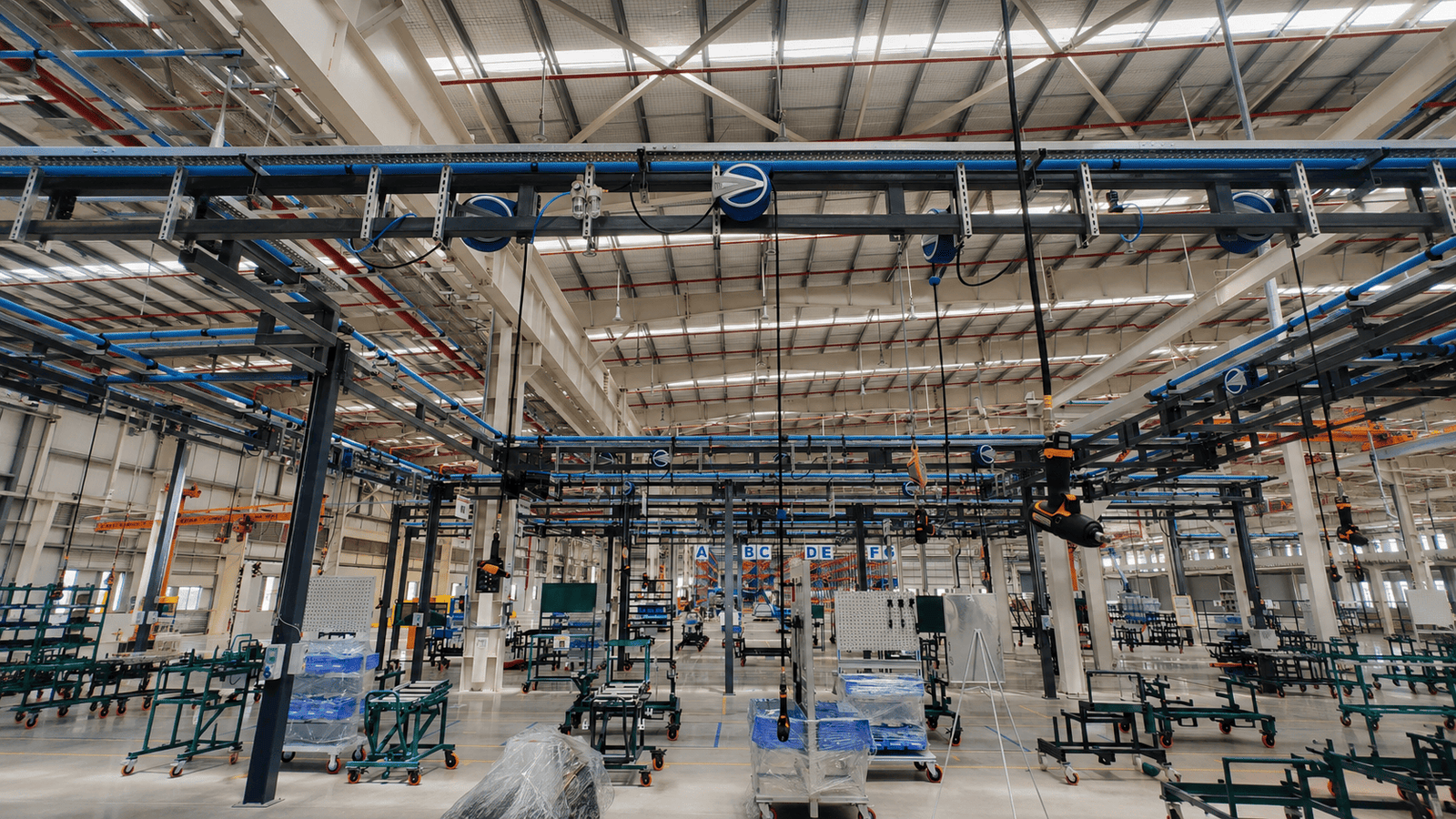
Why Industries Are Switching to Modular Aluminium Piping Systems
Manufacturing plants are moving away from difficult-to-modify conventional pipelines and evaluating modular aluminium compressed air piping for faster assembly, cleaner layouts, easier expansion and more structured long-term utility planning.
Compressed Air Networks Must Keep Up With Changing Production
Modern factories rarely remain static. Machines are added, production cells move, capacity increases and air-demand patterns change.
A compressed air distribution network installed for the original plant layout may become difficult to manage after years of modifications. New branches are added, temporary hoses become permanent, pressure becomes inconsistent and maintenance teams spend more time working around an ageing utility system.
This is one reason manufacturing units are considering a modular aluminium piping system when building a new compressed air network or replacing conventional piping. The interest is not based on appearance alone. It is driven by the need for faster project execution, easier modifications, organised distribution and a network that can support future production changes.
A modular system is not automatically the correct answer for every plant. Pipe size, pressure, airflow, temperature, environment, air-quality requirements and installation quality still determine performance. However, when the system is properly engineered, modular aluminium piping can offer practical advantages for factories that expect their utility network to evolve.
A Coordinated System of Tubes, Connectors, Brackets and Valves
“Modular” means the compressed air distribution network is built from compatible system components rather than treated as a collection of unrelated pipes and fittings.
Aluminium Tubes
Lightweight pipe sections form the main headers, ring mains, branches and machine drops.
Connectors and Fittings
Compatible elbows, tees, reducers, adaptors and flange connections create the required network geometry.
Valves and Supports
Isolation valves, brackets and clamps organise the system into accessible and maintainable zones.
The value of modularity becomes visible when the factory layout changes. A planned connection point can be extended, a drop can be relocated and a production zone can be isolated without rebuilding the entire distribution system. Any modification must still be checked for available flow capacity and pressure drop.
Modular Does Not Mean “Install Without Engineering”
The components may be easier to assemble, but the network still requires a site survey, pipe-size calculation, routing plan, support plan, safety controls, testing and commissioning.
Factories Are Looking Beyond the Initial Pipe Cost
The real comparison between conventional and modular piping is not limited to the price per metre. Plant teams should also evaluate installation labour, shutdown requirements, corrosion exposure, leakage points, maintenance access, modification time and the cost of future production changes.
| Decision area | Challenge in an ageing or frequently modified network | How a modular approach may help |
|---|---|---|
| Plant modification | Extensions may require cutting, threading, welding or extensive rework. | Compatible fittings can make approved branches and drops easier to add or relocate. |
| Project execution | Hot work, surface preparation and complex joining can extend installation time. | Mechanical assembly can reduce the number of fabrication activities at the installation area. |
| Internal condition | Corrosion and scale can create long-term maintenance and airflow concerns in some conventional systems. | Aluminium provides resistance to internal rusting under normal intended compressed-air service. |
| Utility planning | Unplanned additions can create confusing routes and inaccessible valves. | A component-based system supports cleaner zoning, identification and future connection planning. |
| Shutdown management | Replacement can disrupt production if the complete network must be changed at once. | New headers and supports may be installed in phases before controlled final tie-ins. |
1. Reduced exposure to internal rusting
Conventional ferrous pipelines can deteriorate internally when moisture management is poor or the network remains in service for long periods. Rust and debris can contribute to maintenance problems and contaminate downstream components. Aluminium does not internally rust in the same way under normal intended service, although air treatment, filtration and drainage are still necessary.
2. A cleaner, more visible utility layout
Plant teams need to identify mains, branches, valves and machine drops quickly. Consistent pipes, fittings and supports can make the network easier to trace, label and inspect. A clean layout also helps future contractors and maintenance teams understand how the system is organised.
3. Easier long-term planning
A factory may know that another production line will be added in twelve months even if the exact machine positions are not final. A modular network can be planned with suitable header capacity, isolation zones and future connection points so expansion does not begin with a complete redesign.
Mechanical Assembly Can Simplify Project Execution
Modular aluminium systems generally use cut, prepared and mechanically assembled pipe sections. The installation team measures the route, cuts the tube, deburrs and prepares the ends, installs the approved connector and secures the network on planned supports.
This process can reduce dependence on welding and threading activities for the compressed air distribution network. It may also reduce associated tasks such as extensive surface finishing or repainting of the pipe after installation.
Potential Project Advantages
- Lower pipe weight during handling
- Faster section preparation
- Cleaner work around production areas
- Fewer hot-work activities for the pipe network
- Quicker relocation of approved drops
What Still Requires Planning
- Working-at-height controls
- Isolation and depressurisation
- Support spacing and structural checks
- Correct insertion and tightening procedures
- Leakage and pressure testing
Installation Time Depends on the Site
No standard system can guarantee a fixed installation time. Plant height, route complexity, machine access, shutdown windows, pipe sizes and the condition of the existing network all affect the schedule.
A Utility Network That Can Change With Production
One of the strongest commercial reasons to consider modular compressed air piping is the ability to plan for future additions. This is important in facilities where machines are regularly relocated or where new production cells are introduced in phases.
Add a New Production Branch
A planned connection can support a new branch after confirming flow, pressure and header capacity.
Relocate Machine Drops
Approved modular connections can simplify the movement of drops when a production cell changes position.
Create Isolation Zones
Valves can divide the plant into logical operating areas so local maintenance does not require a complete shutdown.
Extend a Ring Main
The network can be designed with future looping or extension in mind, subject to engineering verification.
Expansion flexibility should not be confused with unlimited capacity. Every new machine changes the demand profile. Before adding a branch, the plant should review compressor capacity, dryer and filter capacity, main-header size, simultaneous demand and pressure at the most remote point.
Reduced Leakage Risk Depends on Correct Design and Assembly
Leakage can occur in any compressed air network. It may develop at threaded joints, valves, hoses, couplings, machine connections or poorly assembled fittings. Modular aluminium systems use coordinated connectors and sealing elements, which can reduce the need for numerous fabricated joints when the layout is properly planned.
However, the material alone does not prevent leakage. Correct cutting, deburring, insertion depth, tightening, support spacing, alignment and commissioning remain essential. The plant should also maintain a periodic leak-detection programme after handover.
A Clean Layout Supports Better Maintenance
Accessible isolation valves, clearly labelled zones and visible machine drops make inspection easier. Maintenance teams can identify problem areas faster and record modifications more accurately.
Where Modular Aluminium Piping Adds Practical Value
Automotive and auto-component plants
Automotive facilities regularly modify production cells, tooling stations and assembly layouts. A modular network can support planned relocation of machine drops and expansion of branch lines. The design must account for simultaneous tool demand and high-demand processes.
Pharmaceutical facilities
Pharmaceutical plants require disciplined utility planning. Modular aluminium piping can support an organised distribution layout, but the required compressed-air purity is achieved through the complete system: compressor selection, dryers, filters, drains, monitoring and operating procedures. ISO 8573-1 classifies compressed-air purity in relation to particles, water and oil.
Food and beverage manufacturing
These facilities may use compressed air for packaging, conveying, actuators and process equipment. The piping network should be easy to inspect and coordinated with the required air-treatment strategy. Direct or indirect product-contact applications require application-specific risk assessment.
Packaging plants
Packaging lines often contain multiple pneumatic cylinders, actuators and controls. Production layouts may change when new filling, labelling or wrapping machines are introduced. Modular branches and drops can support these changes when the network has adequate capacity.
General engineering and machine shops
CNC equipment, pneumatic tools, cleaning stations and fabrication machines may operate with different pressure and flow demands. A ring main with properly sized branches can provide an organised basis for workshop expansion.
When Does Replacing an Old Piping System Make Sense?
A full replacement should be based on measured operating problems and long-term plant plans, not only on the age of the pipe. In some cases, targeted repairs or resizing a restricted section may be sufficient. In others, repeated modifications have made the network too inefficient or difficult to maintain.
Operational Warning Signs
- Pressure is unstable at remote machines
- Compressor pressure is raised to compensate for network losses
- Leaks repeatedly return after repair
- Rust, scale or contamination is found downstream
- Sections are visibly damaged or poorly supported
Planning Warning Signs
- The network is undersized for current demand
- Temporary hoses have become permanent distribution lines
- New production zones cannot be isolated properly
- Drawings no longer match the actual installation
- Major plant expansion is approaching
Replacement may also make commercial sense during a planned factory relocation, compressor-room upgrade or major production-line expansion because the plant already has an approved shutdown and access plan.
How to Replace Conventional Piping Without Creating Unnecessary Disruption
Replacing a live factory utility requires more than removing old pipes and installing new ones. The transition should be designed around production continuity, safety and commissioning.
Survey the Existing Network
Record pipe sizes, routes, pressure readings, machine demand, leakage areas and shutdown constraints.
Design for Current and Future Demand
Size the new main header, branches and drops for realistic simultaneous demand and planned expansion.
Install New Supports and Headers in Phases
Where practical, prepare the new network alongside the operating line before the final connection.
Plan Controlled Tie-Ins
Schedule isolation, depressurisation and final connections during approved shutdown windows.
Test and Commission by Zone
Inspect assembly, conduct approved leakage testing and confirm pressure performance under operating load.
Update Drawings and Maintenance Records
Provide as-built layouts, valve identification, test results and future extension points.
Do Not Promise “Zero Downtime” Without a Method Statement
The actual shutdown depends on the existing system, available isolation points, production layout and final connection method. Any continuity plan should state its technical assumptions and contingency measures.
What to Check Before Selecting a Modular Aluminium System
Not all project proposals are equivalent. The plant should evaluate the full network, component range and technical support rather than comparing only tube prices.
Technical Checks
- Operating pressure and temperature rating
- Available pipe diameters and fitting range
- Compatibility of tubes, connectors, seals and valves
- Pipe-sizing and pressure-drop calculations
- Support-spacing and assembly instructions
- Application and environmental suitability
Project Checks
- Site survey and layout support
- Material availability and delivery plan
- Installation tools and trained manpower
- Shutdown and commissioning method
- Documentation and warranty terms
- Availability of future expansion components
ShiftAir’s modular aluminium compressed air piping range includes tubes, connectors, elbows, tees, reducers, valves, brackets, clamps and related accessories for industrial distribution networks. Final selection should follow the approved project design.
Discuss Replacement of Your Old Compressed Air Piping System
If your factory is dealing with recurring leakage, pressure loss, corrosion, undersized lines or difficult expansion, ShiftAir can review the existing network and help define a phased replacement or expansion approach.
Share your factory location, compressor capacity, operating pressure, approximate pipeline length, current pipe material, machine count, known problem areas and planned shutdown window.
Modular Aluminium Piping System FAQs
Continue Your Research
Reference Information
Compressed-air purity requirements should be defined for the application. ISO 8573-1 classifies compressed air in relation to particles, water and oil. System selection and installation should also follow the selected manufacturer’s technical instructions and the plant’s approved engineering and safety procedures.