
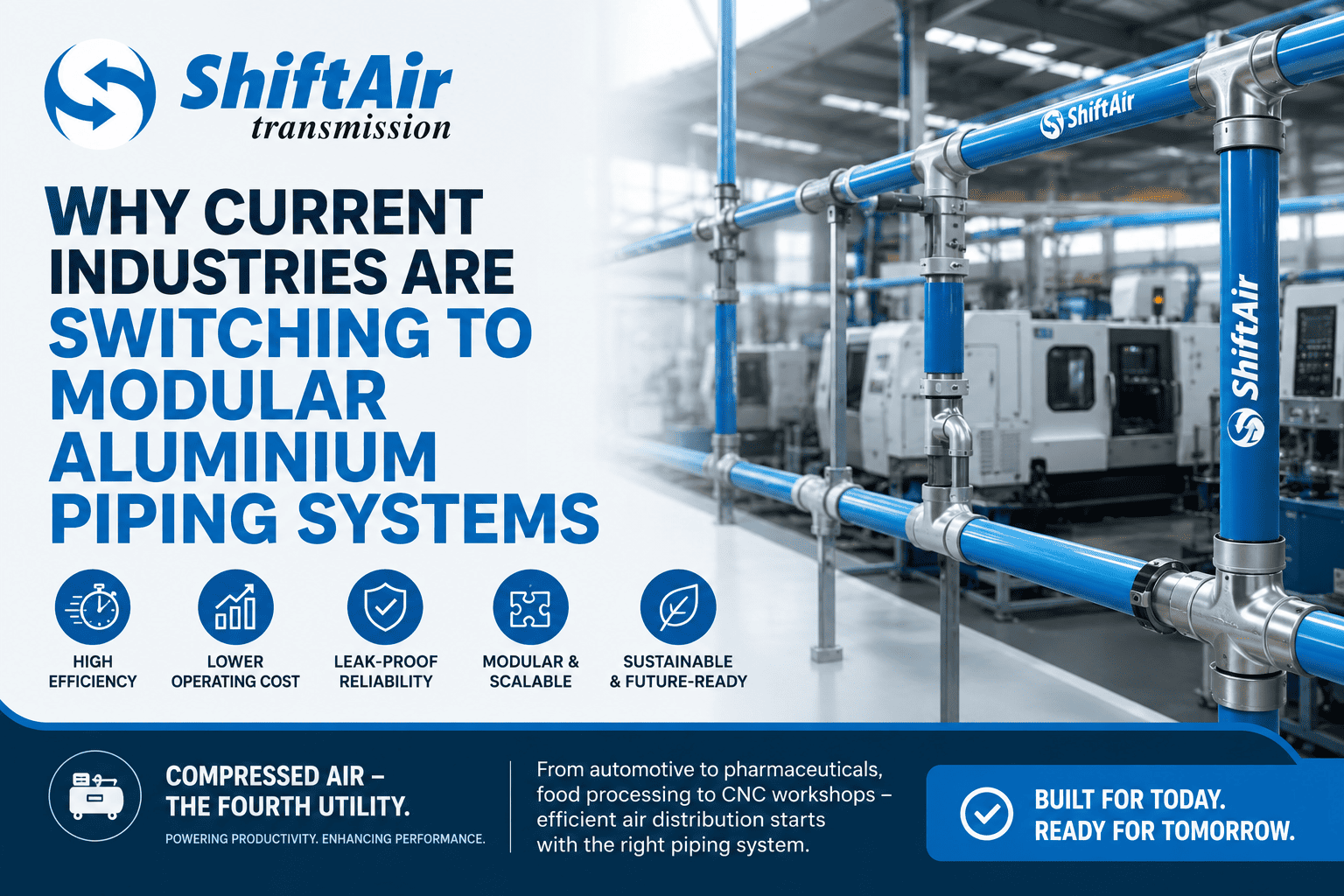
In every modern manufacturing unit, compressed air plays a much bigger role than many people realise. Whether it is an automotive assembly line, a pharmaceutical plant, a food processing unit, a packaging facility, or a CNC workshop, compressed air is used every day to run tools, machines, valves, actuators, conveyors, cleaning systems, and production equipment.
This is why compressed air is often called the fourth utility of industry, standing beside electricity, water, and gas. Without a reliable compressed air network, production can slow down, product quality can be affected, and operating costs can increase.
Most businesses spend a lot of time selecting the right air compressor. They compare capacity, power consumption, brand, service support, and performance. However, the piping system that carries compressed air from the compressor to the production area is often ignored. This is a serious mistake because even the best compressor cannot perform efficiently if the air distribution network is old, corroded, leaking, or poorly designed.
This is one of the main reasons industries are now moving from traditional GI and steel pipelines to modular aluminium piping systems. These modern piping systems are cleaner, faster to install, easier to expand, and more efficient for long-term compressed air distribution.
The Hidden Problem in Many Compressed Air Systems
In many factories, the compressor is blamed whenever there is low pressure at the machine end. The common response is to increase compressor pressure or consider buying a larger compressor. But in many cases, the real problem is not the compressor. The real problem is the piping network.
A compressed air system works efficiently only when the air can move smoothly from the compressor room to every point of use. If the pipeline has internal rust, rough surfaces, leakage points, sharp bends, wrong sizing, or unnecessary pressure drops, the compressor has to work harder to deliver the required pressure. This increases power consumption and reduces the life of the equipment.
Over time, even a small pressure drop can become expensive. A plant may not notice the loss immediately, but the electricity bill keeps increasing month after month. This is why many plant managers are now reviewing not only their compressors but also the complete air distribution system.
Why Traditional GI and Steel Pipelines Are Becoming Less Practical
For many years, GI and steel pipes were commonly used for compressed air lines. They were considered strong, easily available, and familiar to maintenance teams. In older industrial setups, these materials became the default choice because there were fewer alternatives available.
However, manufacturing requirements have changed. Today’s industries need better energy efficiency, faster installation, cleaner air, flexible layouts, and minimum downtime. Traditional GI and steel piping systems often struggle to meet these expectations.
1. Internal Corrosion Reduces Airflow
One of the biggest issues with steel and GI pipes is internal corrosion. Moisture is naturally present in compressed air systems, and when moisture comes into contact with the inner surface of steel pipes, rust starts forming over time.
This rust does not only contaminate the air; it also reduces the internal diameter of the pipe. As the pipe becomes narrower from inside, airflow becomes restricted. The compressor then has to generate more pressure to compensate for the loss. This results in higher electricity usage and reduced system efficiency.
2. Leakage and Pressure Drop Increase Operating Cost
Traditional pipelines usually require threading, welding, or heavy fabrication. Over time, joints can become weak, leakages can develop, and pressure loss can increase. In many facilities, these leakages are treated as small maintenance issues, but they can cause major energy loss when ignored for a long period.
Every air leak means the compressor is producing air that is never used in production. This directly affects operating cost because compressed air is one of the most expensive utilities to generate inside a factory.
3. Modification Is Difficult and Time-Consuming
Factory layouts are not permanent. New machines are added, production lines are shifted, packaging areas are expanded, and workstations are changed. With traditional steel or GI pipelines, making changes is not always easy.
Any modification may require cutting, welding, threading, repainting, and shutdown planning. This increases labour time and may disturb production. For industries working on tight delivery schedules, even a small shutdown can create delays.
4. Maintenance Becomes a Repeated Burden
Steel piping systems often need regular inspection, repair, and replacement of damaged sections. In plants running 24 hours a day, this becomes a continuous burden for the maintenance team. Instead of focusing on improvement and preventive maintenance, the team spends time solving the same pipeline-related problems again and again.
What Is a Modular Aluminium Piping System?
A modular aluminium piping system is a modern compressed air distribution solution designed for speed, cleanliness, flexibility, and long-term performance. Unlike traditional piping, it does not depend on welding, threading, or heavy fabrication.
The system uses lightweight aluminium pipes along with specially designed fittings, connectors, bends, valves, and accessories. These components can be assembled quickly and adjusted easily according to the plant layout.
In simple words, modular aluminium piping works like a smart industrial piping network. It can be installed faster, modified with less effort, and expanded whenever the factory grows. This makes it a practical choice for industries that want a future-ready compressed air system.
Why Industries Prefer Modular Aluminium Piping Systems
The shift toward modular aluminium piping is not just a trend. It is a practical decision based on energy savings, better performance, cleaner air, and easier maintenance. Below are the main reasons modern industries are choosing aluminium piping over traditional systems.
1. Better Airflow and Lower Pressure Loss
Aluminium pipes have a smooth internal surface. This allows compressed air to move more freely through the network. When airflow is smooth, there is less resistance inside the pipe and less pressure drop across the system.
Lower pressure loss means the compressor does not need to work as hard to maintain pressure at the point of use. This improves energy efficiency and helps reduce electricity costs over time.
2. No Internal Rust
Aluminium does not rust internally like steel. This is a major advantage for compressed air applications. Since there is no internal rust, the air remains cleaner and the pipe diameter remains stable for a longer time.
Clean compressed air is especially important in industries such as pharmaceuticals, food processing, electronics, packaging, and precision manufacturing. In these industries, poor air quality can affect equipment performance, product quality, and process reliability.
3. Faster Installation
Modular aluminium piping systems are designed for quick installation. Because the pipes are lightweight and the fittings are easy to assemble, installation can be completed much faster compared to conventional steel piping.
Faster installation means lower labour cost and less disturbance to ongoing production. For factories where downtime is expensive, this is a very important advantage.
4. Easy Expansion and Modification
One of the strongest benefits of modular aluminium piping is flexibility. If a new machine is added or a production line is shifted, the piping network can be extended or modified without major civil work or heavy fabrication.
This makes the system suitable for growing businesses. Instead of replacing the complete network, companies can expand the system step by step as their production needs increase.
5. Lower Maintenance Requirement
Since aluminium piping is corrosion-resistant and uses reliable modular fittings, it requires less maintenance than traditional systems. There are fewer issues related to rust, scaling, leakage, and damaged joints.
This helps the maintenance team save time and reduces the chances of unexpected shutdowns. In the long run, lower maintenance also means better productivity and improved plant reliability.
6. Cleaner and More Professional Plant Layout
Apart from performance, aluminium piping also improves the appearance of the plant. The system looks clean, organised, and professional. Pipes can be installed neatly along walls, ceilings, or production lines, creating a better industrial environment.
A well-planned piping layout also makes inspection easier and helps teams identify future expansion points more clearly.
How Modular Aluminium Piping Supports Different Industries
Different industries use compressed air in different ways, but the need for reliable air distribution is common everywhere. A modular aluminium piping system can support many types of industrial applications.
Automotive Industry
Automotive plants use compressed air for pneumatic tools, robotic systems, painting lines, assembly operations, and testing equipment. A stable compressed air supply helps maintain production speed and consistency.
Pharmaceutical Industry
Pharmaceutical facilities require clean and reliable compressed air for sensitive processes, packaging machines, and controlled production areas. Aluminium piping helps reduce contamination risks caused by internal rust and pipeline deterioration.
Food Processing Industry
In food processing units, compressed air may be used for packaging, cleaning, conveying, filling, and machine operation. A clean and corrosion-resistant piping system supports better hygiene and dependable production.
CNC and Engineering Workshops
CNC workshops depend on compressed air for machine operation, tool cleaning, clamping, and automation support. A well-designed aluminium piping network helps deliver steady pressure to multiple machines without unnecessary loss.
Long-Term Cost Benefits of Aluminium Piping
Some businesses compare piping systems only on the basis of initial cost. This approach can be misleading. A traditional GI or steel system may seem economical at the beginning, but it can become costly over time due to pressure loss, leakage, corrosion, frequent maintenance, and difficult modifications.
Modular aluminium piping may require a higher initial investment, but it offers better long-term value. Faster installation, reduced labour requirement, lower maintenance, fewer leakages, and improved energy efficiency all contribute to cost savings.
In many cases, the savings are not limited to electricity bills. Businesses also save through reduced downtime, quicker expansion, cleaner operations, and longer system life. For plant owners and managers, this makes aluminium piping a practical investment rather than just an equipment purchase.
Can Aluminium Piping Be Connected to an Existing System?
Yes, in many cases modular aluminium piping can be connected to existing steel or GI pipelines with suitable adapters and transition fittings. This is useful for companies that want to upgrade gradually instead of replacing the complete network at once.
A phased upgrade allows businesses to start with critical areas first, such as main headers, high-consumption zones, or sections with frequent leakage. Later, the remaining network can be upgraded according to budget, production planning, and maintenance schedules.
This flexibility makes modular aluminium piping suitable for both new projects and existing factories that want to modernise their compressed air system without unnecessary disruption.
Steps to Plan a Successful Piping Upgrade
Before switching to a modular aluminium piping system, it is important to plan the upgrade properly. A good layout and correct pipe sizing can make a major difference in system performance.
- Inspect the existing air network: Identify leakage points, pressure drop areas, corroded sections, undersized pipelines, and machines that are not receiving proper pressure.
- Check current and future air demand: Measure present air consumption and consider future expansion plans before finalising the piping size.
- Get a professional site survey: An experienced piping provider can recommend the right layout, pipe diameter, fittings, drops, valves, and accessories.
- Plan installation timing: Schedule installation during planned shutdowns, weekly offs, or low-production periods to avoid unnecessary disturbance.
- Train the maintenance team: Make sure the team understands the new system, fittings, inspection process, and basic maintenance requirements.
- Monitor performance after installation: Track pressure stability, leakage reduction, compressor load, energy consumption, and maintenance frequency.
Why Choosing the Right Piping Partner Matters
The performance of a compressed air piping system depends not only on the material but also on design, installation quality, and technical support. A poorly designed aluminium system may not deliver the expected results even if the material is good.
Businesses should choose a piping partner with proper industry experience, technical knowledge, reliable products, and strong after-sales support. The provider should be able to understand the plant layout, air demand, pressure requirements, safety needs, and future expansion plans.
A good piping partner will not simply supply pipes and fittings. They will help design a system that supports productivity, reduces losses, and remains useful as the factory grows.
Conclusion
Modern industries cannot afford frequent air leakage, pressure loss, corrosion, and repeated maintenance problems. As production systems become faster and more demanding, the compressed air network must also become more efficient and reliable.
Modular aluminium piping systems offer a practical solution for today’s industrial needs. They provide smoother airflow, cleaner air distribution, faster installation, easier expansion, lower maintenance, and better long-term savings compared to traditional GI and steel piping systems.
For automotive plants, pharmaceutical facilities, food processing units, CNC workshops, and other industrial operations, switching to modular aluminium piping is not just about replacing old pipes. It is about building a stronger, cleaner, and more future-ready compressed air infrastructure.
If your facility is facing pressure drops, frequent leakage, high compressor load, or regular pipeline maintenance, now is the right time to review your compressed air distribution system and consider a modern modular aluminium piping solution.
“`